Best Agent Skills for Research in 2026
Discover the 7 best AI agent skills for research in 2026 — from academic literature reviews to real-time trend tracking. Find the right skill for Claude, Codex, or Hermes.
Research is one of the most time-consuming parts of any knowledge worker's job — and one of the first to be reshaped by agent skills. Unlike a chatbot that answers from memory, a research skill gives an AI agent a repeatable, source-grounded workflow: where to search, how to verify, how to cite, and what to hand off next.
We looked at seven of the most useful research-focused agent skills available right now for Claude, Codex, and Hermes. They cover from academic literature reviews to people search, real-time trend tracking, and the raw web access that powers all of it.
Quick Comparison
| Skill | Layer | Best for |
|---|---|---|
| Hermes Research Skills | Academic Discovery | Paper search, feed monitoring, prediction markets |
| Content Research Writer | Content Creation | Outlining, citation management, hook optimization |
| Local Deep Research | Deep Research Engine | Autonomous multi-source research, private knowledge base |
| Lessie | People Intelligence | Contact finding, company research, lead generation |
| NotebookLM Skill | Document Research | Source-grounded research from your own documents |
| Last30Days | Signal Detection | Real-time trend discovery across social platforms |
| Bright Data MCP | Web Infrastructure | Unblocked web access and data extraction |
How We Selected These Skills
We evaluated agent skills based on a few criteria:
- Breadth of coverage across different research needs (academic, content, privacy, people search, trend tracking, and infrastructure)
- Whether each skill offers a genuinely repeatable workflow rather than a one-off prompt.
- Ease of setup and integration with Claude, Codex, or Hermes, and real differentiation — each tool included here serves a distinct use case rather than overlapping heavily with another entry on the list.
We prioritized skills that are actively maintained, have clear documentation, and either offer a free tier/open-source option or provide enough value to justify a paid plan.
The 7 Best Agent Skills for research in 2026
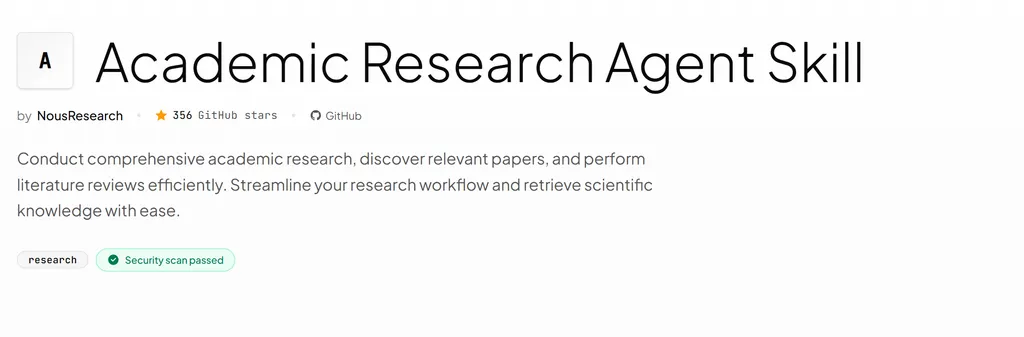
Academic Research Agent Skill
Visit at: https://nanoskill.ai/skills/academic-research-skill
Best for: Technical and academic teams running a full research-to-publication loop.
Hermes Agent is a self-improving agent with a built-in learning loop, and its research skill set is built for serious end-to-end work. The flagship research-paper-writing skill covers the full lifecycle for producing publication-ready ML/AI papers — literature review via arXiv and Semantic Scholar, experiment execution and monitoring, analysis, drafting, and revision. It's designed as an iterative loop rather than a linear pipeline: results trigger new experiments, and reviews trigger new analysis.
Why it's great: Few skills go beyond "find information" into actually managing the research lifecycle — running background experiments, tracking logs, and drafting from real results.
Limitations: Built around Hermes's tooling (delegation, scheduling, memory), so it's most powerful inside that ecosystem rather than as a standalone drop-in.
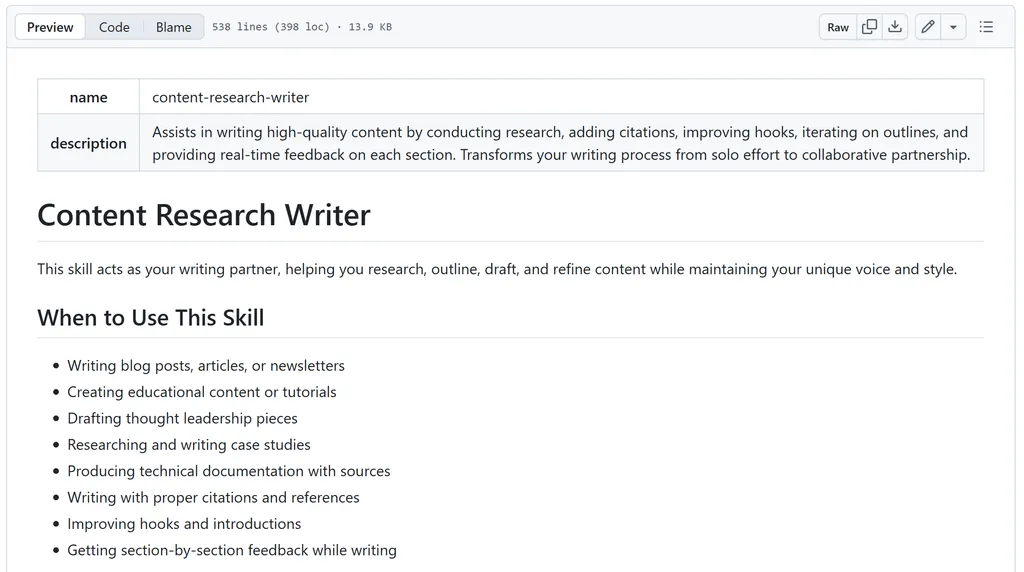
Content Research Writer
Visit at: https://nanoskill.ai/skills/content-research-writer
Best for: Bloggers, newsletter writers, and content marketers who want research woven directly into drafting.
This skill turns research into publishable writing in one workflow. It's a research-powered writing partner that researches, outlines, drafts, and refines content while preserving your voice — adding citations, improving hooks, and giving section-by-section feedback as you write. It organizes everything into a clean folder structure: outline, research notes, sourced material, and versioned drafts.
Why it's great: Instead of treating research and writing as separate steps, it keeps a running research file that feeds directly into your draft — useful for thought-leadership posts and articles that need to read as "yours."
Limitations: It's a writing-first skill — for deep multi-source synthesis on a topic before you've decided what to write, pair it with a dedicated research tool like Local Deep Research.
Local Deep Research
Visit at: https://github.com/LearningCircuit/local-deep-research
Best for: Privacy-conscious researchers who need full control over models, data, and sources.
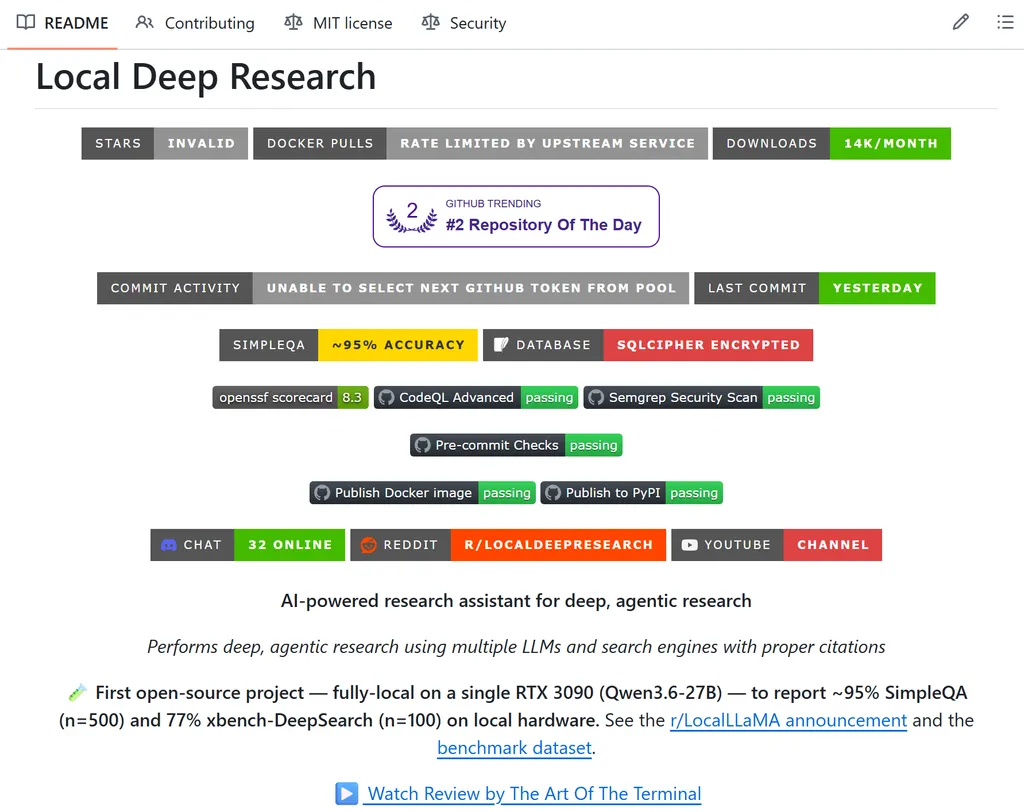
For anyone who wants research done entirely on their own infrastructure, Local Deep Research is hard to beat. It performs deep, agentic research using multiple LLMs and search engines with proper citations, searching 10+ sources including arXiv, PubMed, the web, and your own private documents — everything local and encrypted, with no telemetry, analytics, or tracking.
Why it's great: It's one of the few open-source tools benchmarked on SimpleQA, and it works with local LLMs via Ollama as well as cloud providers — so you can scale from a laptop to a GPU server without switching tools.
Limitations: Self-hosted setup (Docker, Ollama, SearXNG) takes more effort than installing a skill — it's a research platform, not a quick plug-in.
People Search Agent Skill
Visit at: https://nanoskill.ai/skills/people-search
Best for: recruiters, sales teams, and anyone doing prospecting or due diligence on people and companies.
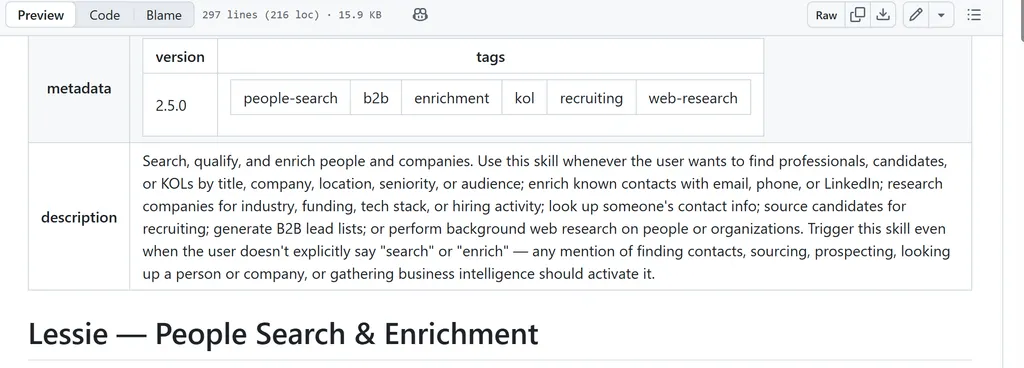
This skill specializes in finding and enriching information about people and organizations directly from natural-language commands in Claude Code. It supports candidate sourcing, B2B lead generation, contact enrichment (email, phone, LinkedIn), and company research covering industry, funding, tech stack, and hiring activity — plus background intelligence on individuals or organizations.
Why it's great: A single command like "Find Engineering Managers at Stripe" triggers multi-source search and ranking, replacing a chain of separate LinkedIn searches, list-building tools, and enrichment lookups.
Limitations: The skill is a thin client over LessieAI's hosted service, so it requires an account and credits beyond the free trial for heavier usage.
NotebookLM Research Skill
Best for: Content teams who want source-grounded research handed straight to a writing agent.
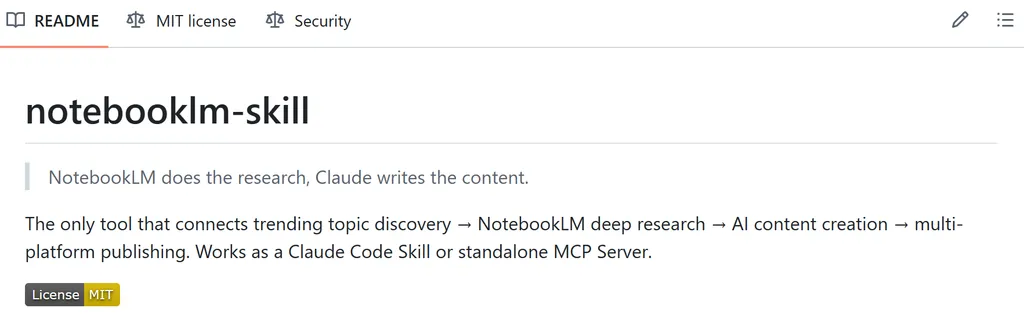
This skill sets up a clever two-agent handoff: NotebookLM does the deep, source-grounded research, and Claude writes the content. Feed it URLs, PDFs, or trending topics, and it creates a NotebookLM notebook, runs deep research queries, and hands structured findings to Claude for polished output — articles, social posts, newsletters, or podcasts.
Why it's great: NotebookLM's grounding (answers based only on the sources you provide) combined with Claude's writing means less hallucination and less manual copy-pasting between tools.
Limitations: Works best for content built from a defined set of sources rather than open-ended exploratory research across the live web.
last 30days
Visit at: https://nanoskill.ai/skills/social-listening-skill
Best for: Trend research, sentiment checks, and "what's the internet saying" briefs.
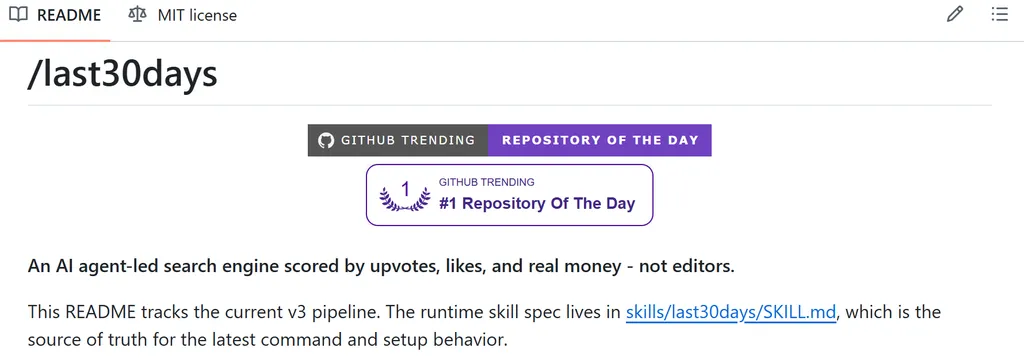
If "research" means understanding what people are actually saying right now, last30days is built for exactly that. It searches Reddit, X, YouTube, Hacker News, Polymarket, and the web in parallel, scores results by what real people actually engage with, and uses an AI agent judge to synthesize everything into one grounded brief. Reddit, Hacker News, Polymarket, and GitHub work with zero configuration, with an optional setup wizard to unlock X, YouTube, and TikTok.
Why it's great: It's a strong fit for marketing and product teams who need to know what's trending or how a topic is being discussed — backed by real engagement signals (upvotes, likes, prediction-market odds) rather than generic web summaries.
Limitations: Optimized for recent, discussion-driven topics — not a substitute for deep academic or historical research.
brightdata-mcp
Visit at: https://github.com/brightdata/brightdata-mcp
Best for: powering any of the above skills when the bottleneck is reaching the web itself.
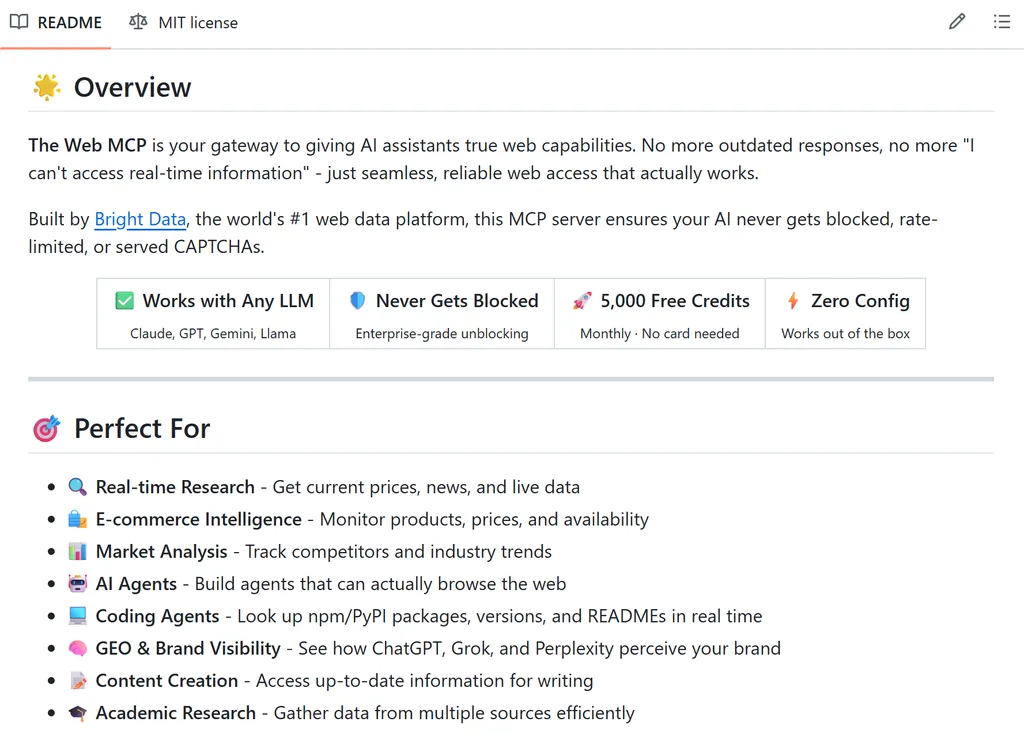
Rather than a research skill in the traditional sense, this is an MCP server that gives any agent reliable access to the live web. It's built to ensure your AI never gets blocked, rate-limited, or served CAPTCHAs. The free tier covers web search, scraping with web unlocker, and AI-ranked discovery search, while pro mode unlocks browser automation and 60+ additional web data tools.
Why it's great: Many research skills are only as good as their underlying web access. Bright Data MCP is a drop-in upgrade — connect it once via Claude Desktop's connector settings or a local MCP config, and every research skill that relies on web search or scraping benefits.
Limitations: It's infrastructure, not a research methodology — pair it with one of the skills above rather than using it on its own.
Choosing the Right Research Agent Skill
Pick a skill based on what your research is for, not just what's popular.
- If you need citation-backed academic outputs, look for tools built around arXiv, PubMed, and iterative experiment loops.
- If research feeds directly into published content, choose a skill that drafts as it researches rather than treating the two as separate steps.
- For privacy-sensitive work, self-hosted options keep data and queries local.
- For real-time market or audience research, you need engagement-weighted social search, not academic databases.
And underlying all of it: a skill is only as good as its web access — if scraping gets blocked, the workflow stalls regardless of how smart the analysis is.
Quick framework: do you need (1) citations, (2) finished content, (3) local/private data, (4) live sentiment, or (5) better raw web access? Match accordingly.
FAQs
What is an agent research skill?
An agent research skill is a specialized capability that enables AI agents to search, extract, analyze, and synthesize information from diverse sources — academic databases, web pages, social platforms, APIs, and private knowledge bases. Different skills focus on different research tasks, such as paper discovery, content writing, people search, or web scraping.
Do these research skills require sending data to third-party services?
Not always. Some run entirely on local infrastructure, searching your own documents and public databases without telemetry. Most lighter-weight skills, however, are thin clients over hosted services and require an account, internet access, and sometimes usage credits.
What should content creators use?
A skill that combines research and drafting in one workflow — generating outlines, sourced notes, and versioned drafts as you go — so research output becomes a draft directly, rather than requiring a separate writing tool.
What's the best tool for tracking what people are saying online right now?
A trend-research skill that searches platforms like Reddit, X, YouTube, and Hacker News in parallel and ranks results by real engagement (upvotes, likes, prediction-market odds) rather than generic relevance.