Best Cold Email Agent Skills in 2026
Discover the best cold email agent skills for lead generation, personalized outreach, follow-ups, and reply automation.
If you're doing outbound sales, you probably don’t want your cold emails to sound generic, badly personalized, or obviously AI-generated.
The best cold email agent skills go far beyond simple prompt writing. They can research leads, generate contextual personalization, automate follow-ups, classify replies, and optimize outreach workflows automatically.
In this guide, we tested some of the best cold email agent skills to see which ones actually improve prospecting. Whether you're a founder doing outbound, an SDR team scaling prospecting, or an agency running client campaigns, you'll probably find something useful.
The Modern AI-powered Cold Email Workflow
Before diving into specific skills, it’s helpful to understand how AI agents fit into a modern cold email workflow. Most cold email workflows can be broken down into four core stages:
- Lead Research & Qualification: AI agent skills can help identify higher-quality prospects before outreach begins by analyzing buying signals, company activity, and ICP fit.
- Personalization & Email Writing: Instead of generating generic templates, modern cold email skills focus on contextual personalization, conversational phrasing, and follow-up sequencing.
- Outreach Automation & Follow-Ups: Some skills are designed around outbound workflows, helping automate follow-up timing, messaging variations, and campaign structure.
- Reply Handling & Optimization: More advanced agent skills can classify replies, prioritize responses, and help teams manage outreach pipelines more efficiently.
How We Picked the Best Cold Email Agent Skills
We installed and tested a range of cold email agent skills inside OpenClaw. Instead of only looking at feature descriptions, we focused on how useful the skills actually felt during real cold email tasks.
We also compared some outputs against generic AI prompts to see whether the skills actually improved outreach quality.
Here’s what we evaluated for each skill:
| Evaluation Criteria | What We Looked For |
|---|---|
| Personalization Quality | Whether the skill generates contextual, human-like outreach |
| Workflow Automation | Ability to automate follow-ups, lead research, or reply handling |
| Ease of Setup | How quickly the skill can be configured and deployed |
| Output Quality | Clarity, structure, and usefulness of generated emails |
| Deliverability Awareness | Whether the skill avoids spammy wording and bad practices |
| Real-World Use Cases | Practical value for SDRs, founders, recruiters, and agencies |
Best Cold Email Agent Skills in 2026
These skills were selected and organized based on real cold email workflows.
1) Outbound Prospecting Workflow
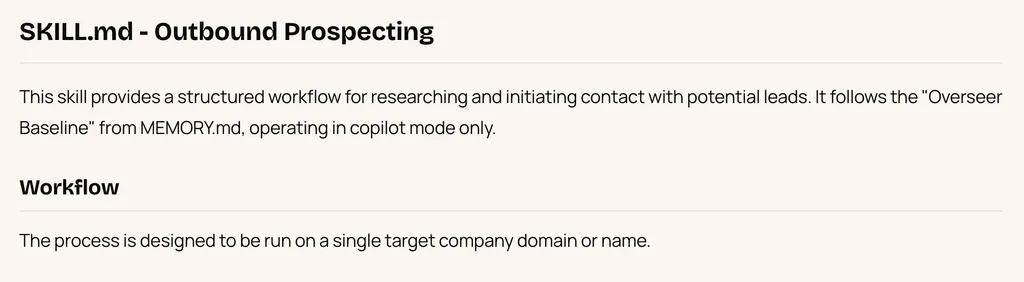
Best for: Outbound prospecting and personalized cold outreach based on real company informations.
What it does
This skill focuses on outbound research workflows rather than just email writing. It helps:
- research target companies using recent news, websites, and positioning
- identify likely decision-makers for outreach
- uncover personalization opportunities and timing triggers
- analyze potential pain points and growth signals
- generate more context-aware cold outreach drafts
Example Use Case
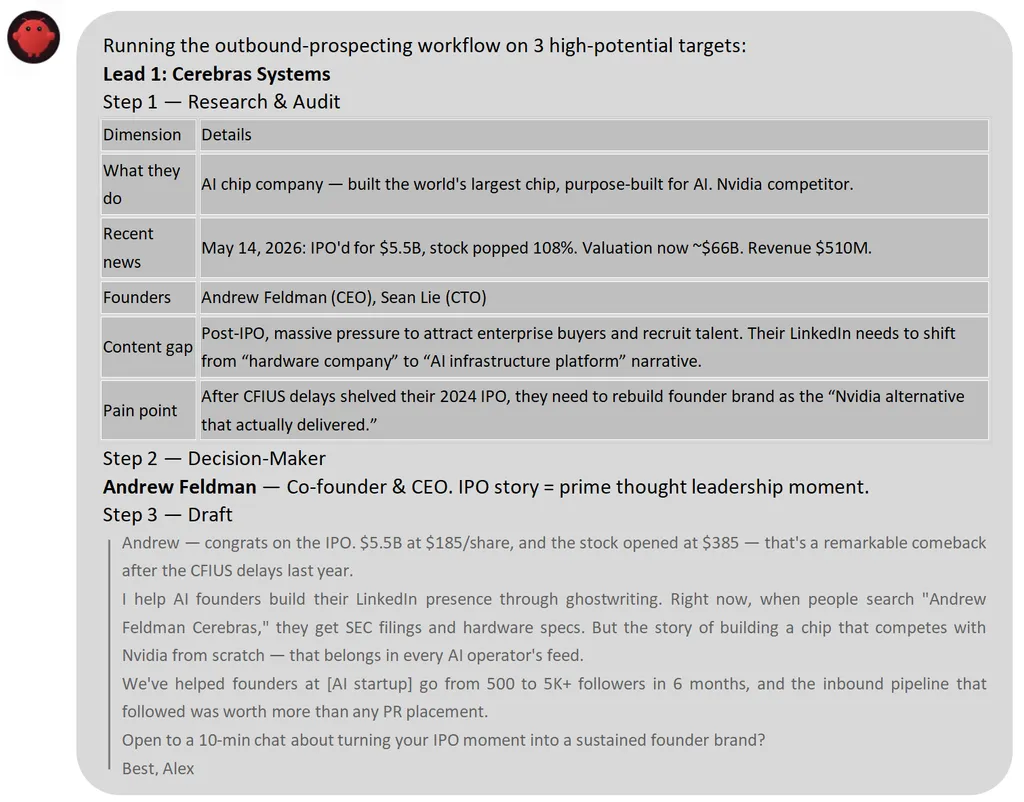
We tested this skill by asking it to find outbound leads for a LinkedIn ghostwriting agency targeting AI startup founders.
The skill first researched each company, analyzed recent events, identified founder positioning opportunities, and then selected relevant decision-makers before drafting outreach.
One interesting example was its analysis of Cerebras Systems after its IPO. The skill connected the company’s post-IPO narrative, founder visibility, and AI infrastructure positioning to potential LinkedIn thought leadership opportunities, then used those findings to generate a much more contextual outreach angle.
Limitations
The skill improves outbound research quality, but it is not a fully autonomous lead generation tool. Some personalization still depends on assumptions rather than verified prospect data.
2) Lead-scoring (qualification)
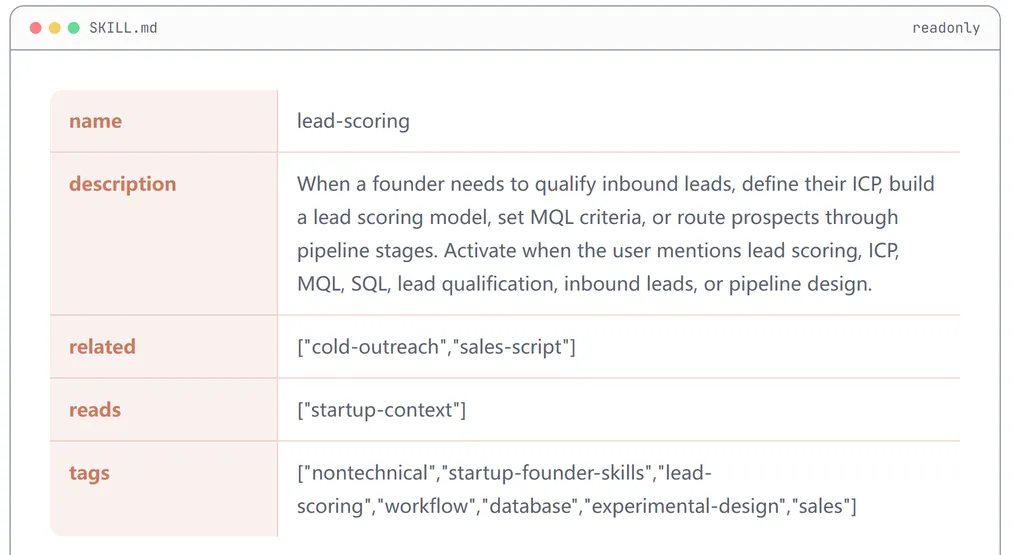
Best for: Prioritizing high-potential cold outreach leads.
What it does
This skill focuses on lead qualification and outbound prioritization rather than email generation itself. It helps:
- score leads based on ICP fit and buying signals
- identify higher-priority outbound opportunities
- analyze growth indicators like hiring, funding, and content activity
- provide sales-oriented reasoning behind lead rankings
- recommend outreach urgency and next actions
Compared to standard AI lead scoring prompts, the outputs feel more structured, action-oriented, and aligned with real SDR workflows.
Example Use Case
We tested this skill by asking it to rank and prioritize three different outbound leads for a LinkedIn content agency.
The skill generated structured lead evaluations based on specific factors. In addition, the outputs included detailed breakdowns explaining why certain accounts were stronger outbound opportunities than others.
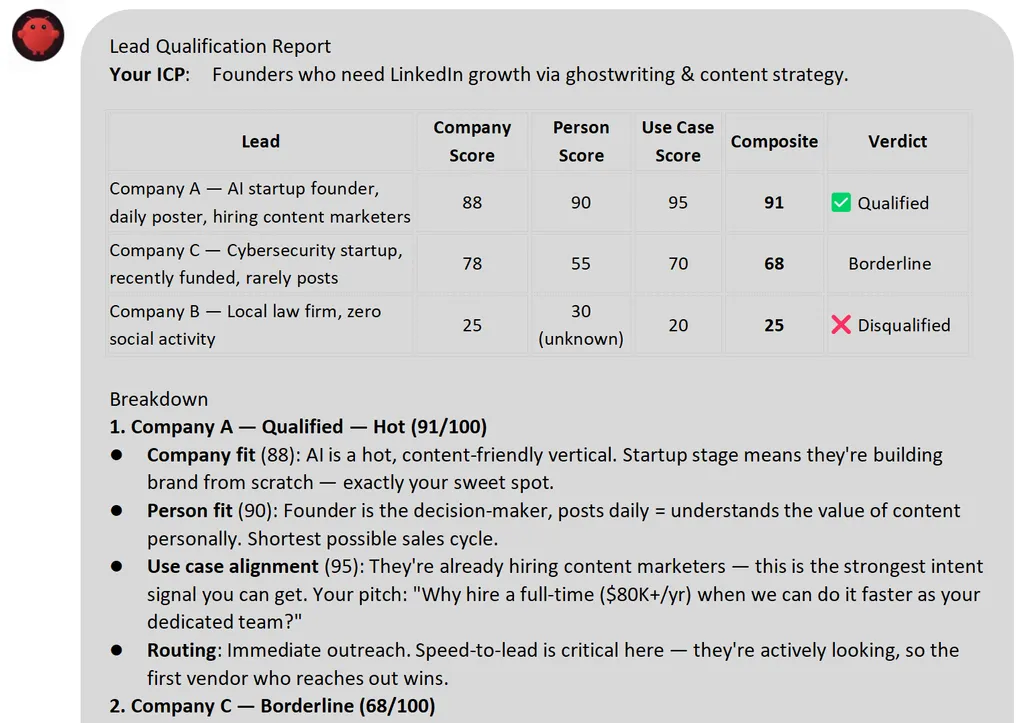
Worth mentioning, the skill didn't just rank leads — it also created an action plan, suggesting outreach priority, messaging direction, and whether certain prospects should be skipped entirely.
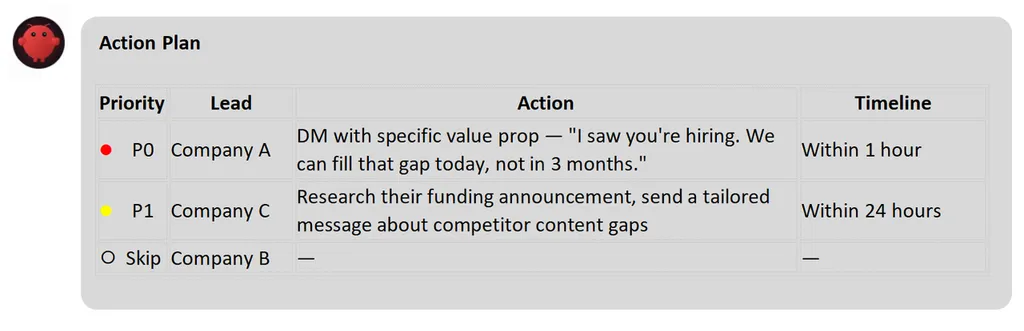
Nevertheless, the outputs can sometimes become overly detailed for simple outbound workflows, and some recommendations rely on assumptions rather than verified buying intent. The scoring quality also depends heavily on how much lead context is provided in the prompt.
3) Cold Email Personalization
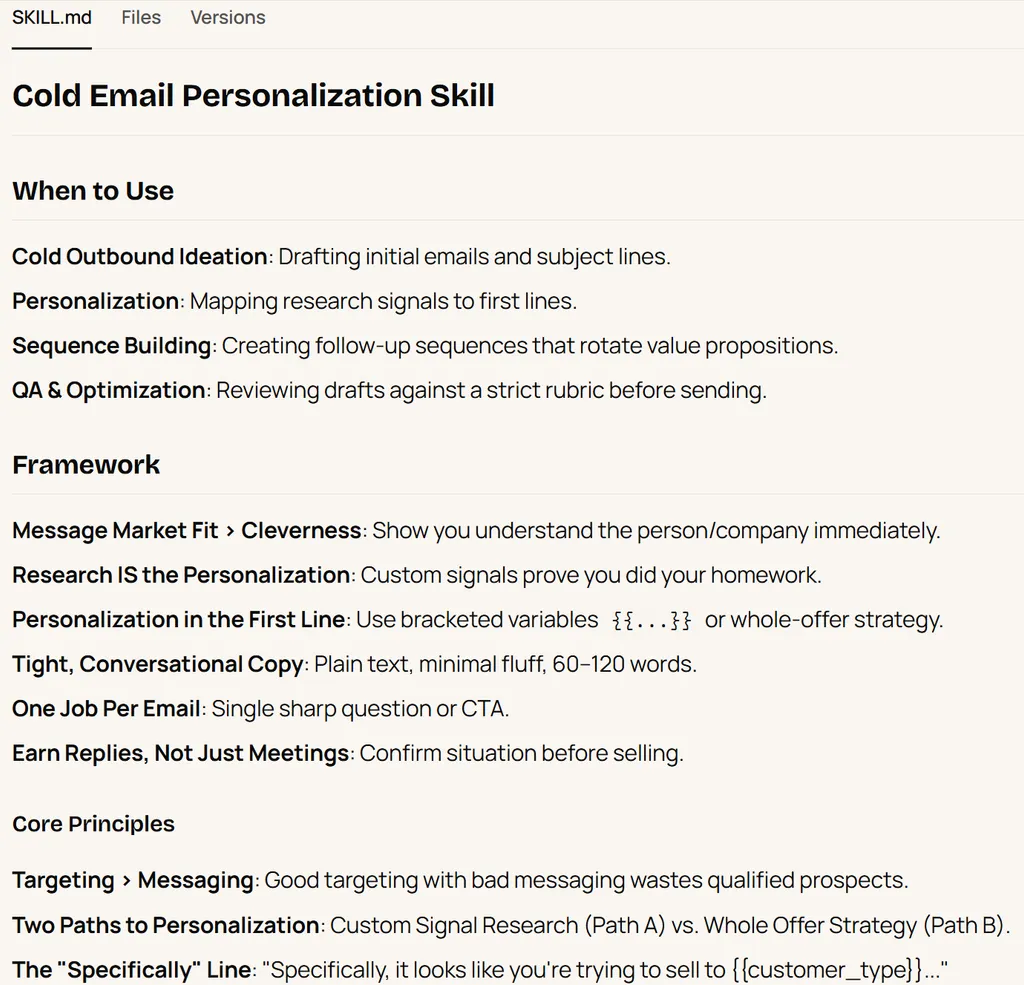
Best for: Making cold outreach feel more human, conversational, and less obviously AI-generated.
What it does
This skill focuses on making cold outreach feel more natural and less AI-generated. It emphasizes:
- conversational phrasing
- contextual personalization
- low-friction CTAs
- shorter, deliverability-friendly emails
- anti-template outreach frameworks
It can make the outputs less sales-heavy and more focused on relevance, brevity, while being human-like tone.
Before vs After
In a podcast outreach scenario targeting AI startup founders, we used this skill to refine and rewrite cold email messaging for higher response likelihood.
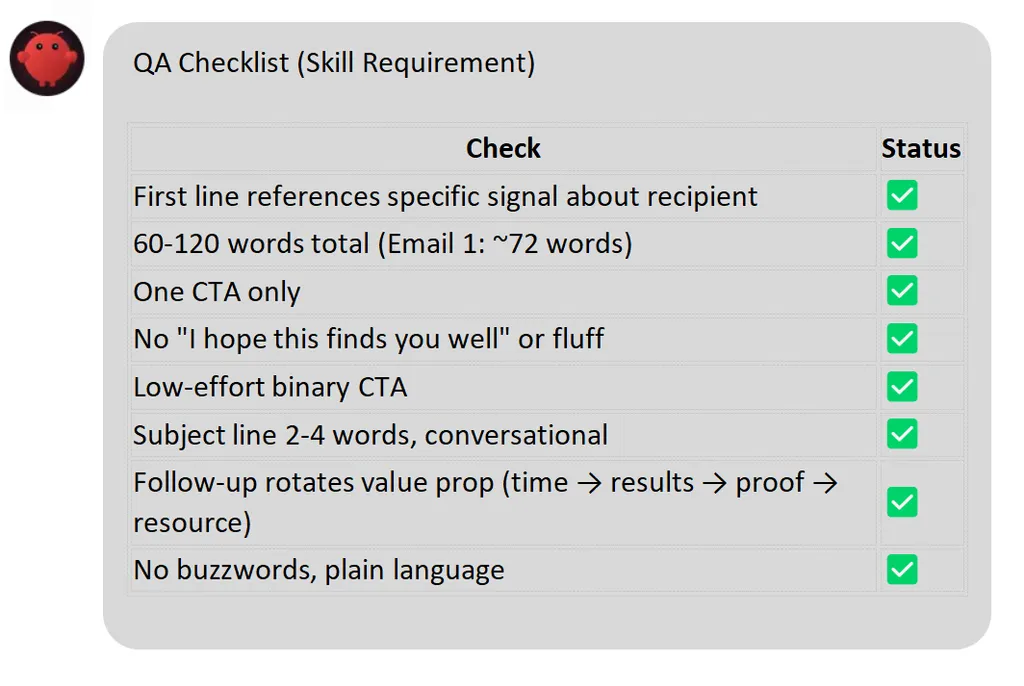
Without the skill, the output felt more like a traditional AI-written sales email with longer explanations, broader positioning, and more generic outreach structure.
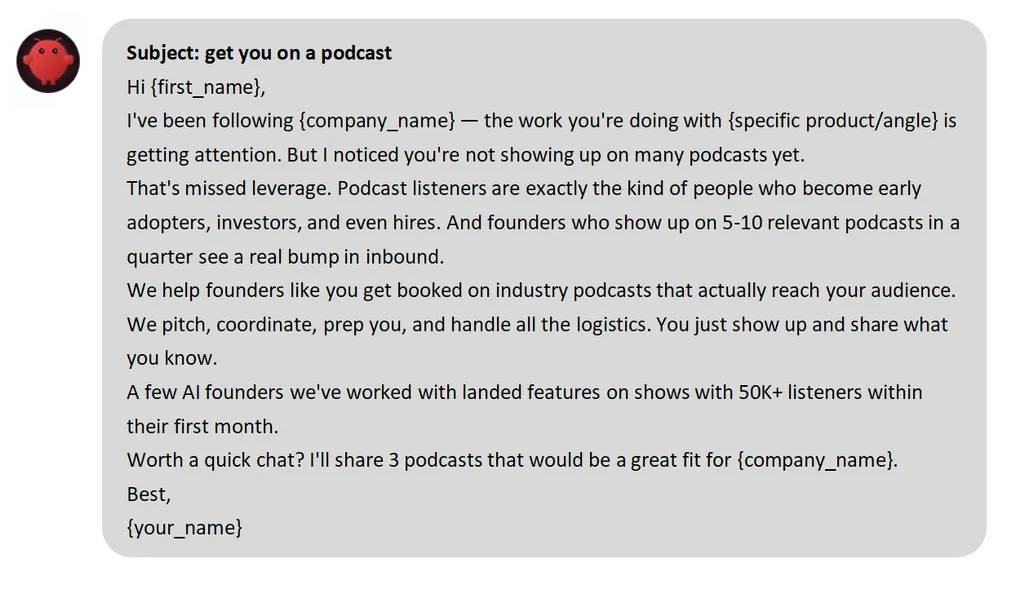
After enabling the skill, the emails became shorter, more conversational, and significantly less sales-heavy. The messaging relied more on contextual openers, plain-language phrasing, and low-effort CTAs instead of polished marketing copy.
Another noticeable highlight was the built-in anti-AI writing framework. The skill explicitly avoided fluff, overly formal phrasing, and spam-like sales language that often makes AI cold emails feel templated.
Cons
The outputs can sometimes feel overly minimalist, especially for more complex offers that need additional explanation or trust-building. Some personalization still relies on placeholders and assumptions, and the shorter style may feel too lightweight for certain industries or enterprise outreach scenarios.
4) Cold Email Writer (follow-up)
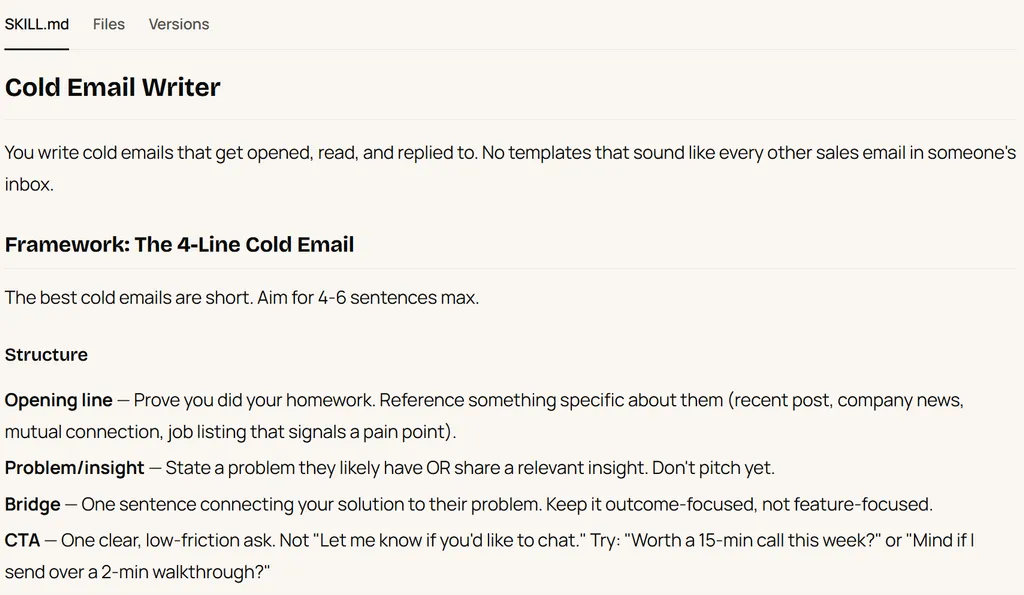
Best for: Generating personalized cold email sequences and follow-ups.
What it does
This skill generates multi-step cold email sequences instead of just a single outreach email. It helps create:
- personalized outreach
- follow-up emails
- value-driven CTAs
- sequence-based outbound workflows
Unlike standard cold email prompts that usually generate isolated emails, this skill is designed around longer outbound sequences and follow-up progression.
Example Use Case
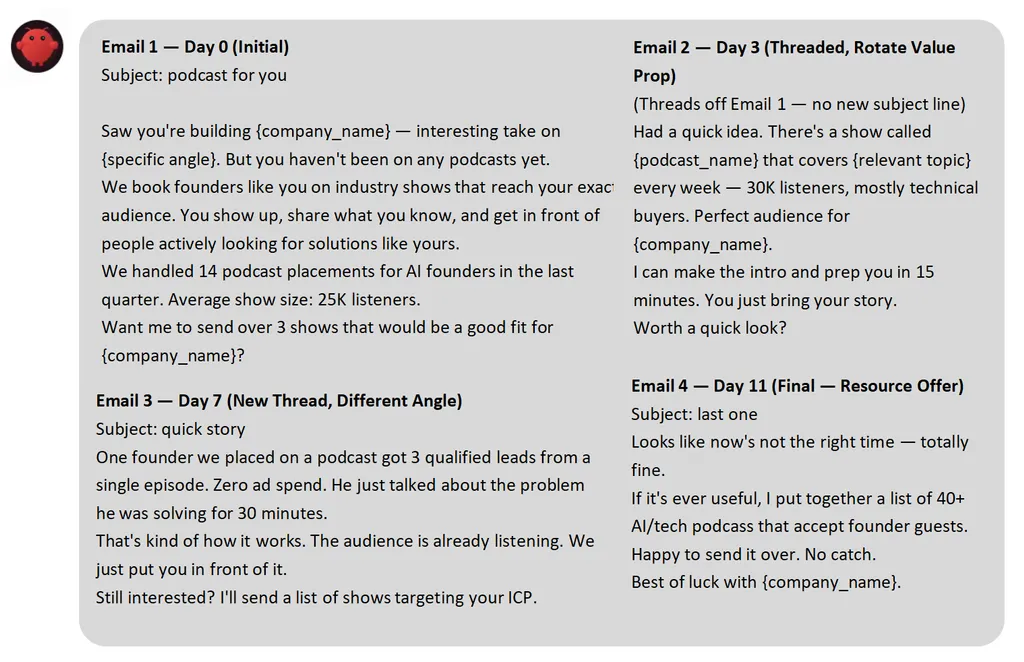
We tested this skill using a cold outreach scenario for an AI content marketing agency targeting SaaS marketing teams.
As a result, the skill created a full 4-step outreach sequence with different follow-up angles.
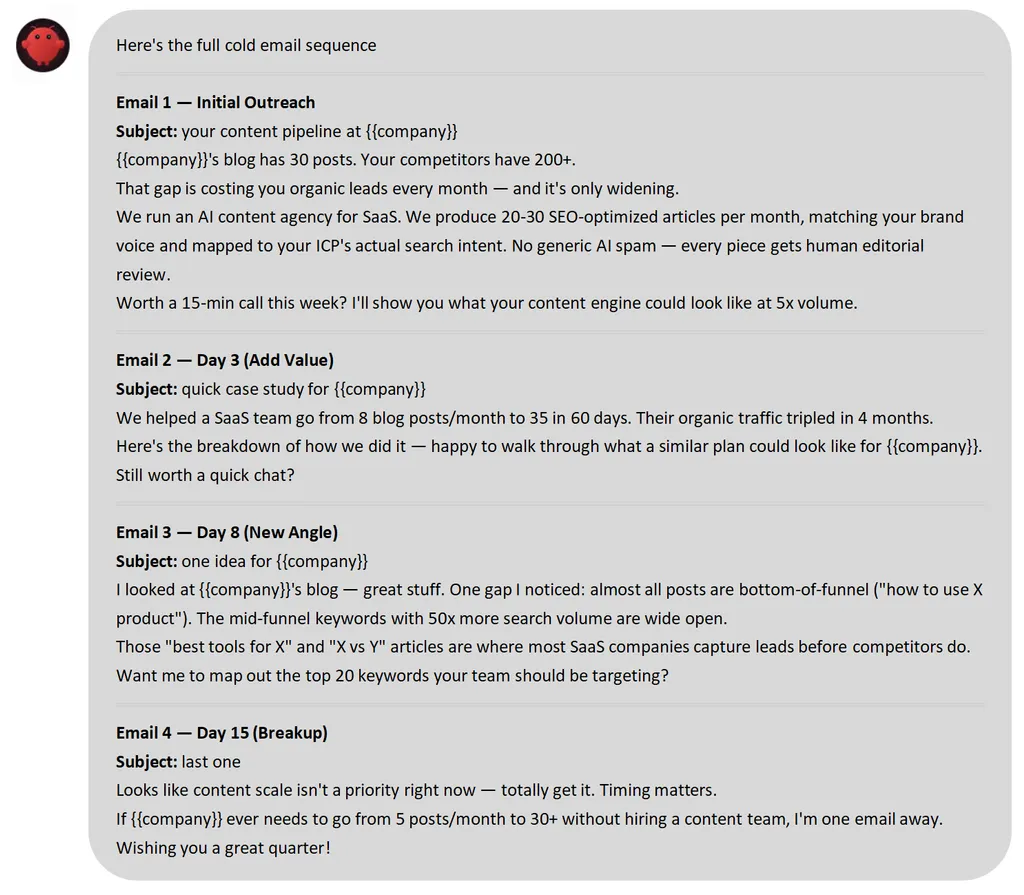
One thing that stood out was how the follow-ups evolved throughout the sequence. Rather than repeating the same pitch repeatedly, later emails introduced new hooks, softer CTAs, and different positioning angles to keep the outreach from feeling overly repetitive.
However, some personalization still feels slightly templated, and parts of the messaging can sound overly aggressive depending on the audience. Some contentalso rely on assumptions about the prospect’s business without enough real context.
5) YC Cold Outreach (optimization)
Best for: Auditing and improving cold emails before launch
What it does
This skill focuses more on cold email critique and optimization than pure generation. It helps:
- review cold emails using YC startup outreach principles
- identify overly salesy or AI-generated phrasing
- evaluate personalization, friction, and readability
- improve CTAs and conversational tone
- rewrite outreach to feel more founder-to-founder
Compared to standard AI feedback, the critiques feel much more specific, tactical, and aligned with real startup outbound practices.
Example Use Case
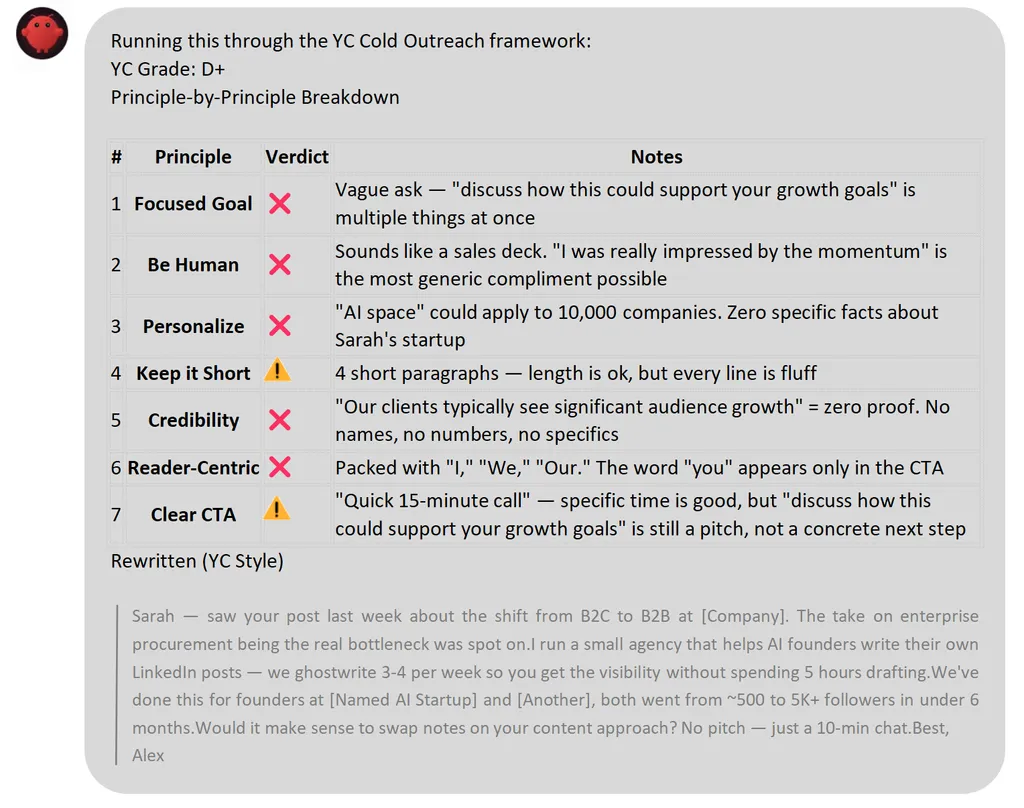
We ran this skill through a cold email audit scenario, using a real outreach message sent to AI startup founders as the input:
Hi Sarah,
I came across your company and was really impressed by the momentum your team is building in the AI space.
We help startups leverage AI-powered LinkedIn content strategies to increase visibility, engagement, and inbound pipeline growth without needing to hire a full internal content team.
Our clients typically see significant audience growth and stronger founder branding within a few months.
Would you be open to a quick 15-minute call next week to discuss how this could support your growth goals?
Best,
Alex
Founder, Peak Narrative
Then, the skill clearly explained why certain phrases felt overly salesy, generic, or AI-generated instead of giving vague copywriting advice. It pointed out specific issues and suggested more natural rewrites, which can make the message feel closer to real founder-to-founder outreach.
Cons
The feedback can sometimes feel overly harsh or startup-centric, especially for more traditional industries or enterprise sales workflows. Some recommendations also assume you already have strong personalization data, customer proof, or founder context available.
6) Cold Email Outreach (automation)
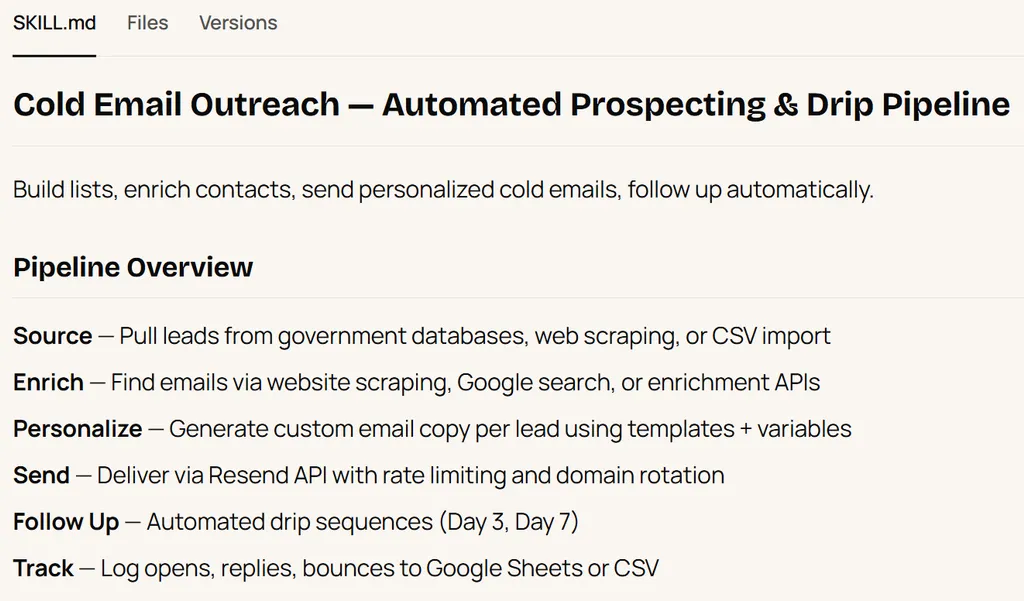
Best for: Designing and executing cold email outreach at scale.
What it does
We tested this skill in dry-run mode without connecting a real sending domain.
Instead of evaluating actual deliverability, we focused on:
- outreach sequencing
- follow-up structure
- messaging variety
- deliverability-friendly copywriting
This skill feels more like a lightweight outbound system than a simple AI email writer. Even in dry-run mode, the workflow structure and follow-up sequencing felt more realistic than standard AI-generated outreach.
To our pity, without configuring a sending domain, most of the advanced outreach automation features can only be previewed rather than fully tested in real campaigns.
Beyond Templates: Why Choose Agents Skills Today?
In 2026, the gap between traditional AI and Cold Email Agents is defined by context vs. syntax. Traditional AI just writes sentences; Agents execute strategy.
The shift is driven by three core edges:
- Deep Research: Instead of static placeholders, agents scan real-time signals (like IPOs, news, or founder interviews) to find a genuine "Why Now."
- Autonomous Filters: Agents can score leads and auto-disqualify those that don't fit your ICP, protecting your domain reputation.
- Adaptive Follow-ups: Unlike rigid sequences, agents pivot their messaging based on how much time has passed and any new company triggers that occurred during the silence.
Ultimately, traditional AI focuses on sending, while Agent Skills focus on converting.
The Verdict: Building Your AI Outreach Engine
The era of "spray and pray" has ended. High-performing outbound in 2026 relies on agent-led precision. As shown by tools in the article, success belongs to those who prioritize relevance over volume.
To scale effectively, shift your focus:
Stop writing, start researching. Use AI as an analyst first, and a writer second.
Chain your skills. Filter leads before generating a single email.
Humanize the tone. Strip away "AI-speak" to bypass modern spam filters.
By integrating these specialized skills into your workflow, you transform cold outreach from a manual numbers game into a scalable, intelligent revenue engine.