Humanizer-zh: AI Writing Trace Removal Tool (Chinese Version)
Disclaimer:
- The core files of this project are translated from blader/humanizer
- The utility parts (core rules, quick checklist, quality scoring) reference hardikpandya/stop-slop
- The original project is based on Wikipedia's Signs of AI writing guide
Project Introduction
Humanizer-zh is a tool for removing AI-generated traces from text, helping you rewrite AI-generated content to sound more natural and human-written.
This project is suitable for:
- Editing and reviewing AI-generated content
- Improving the human-like quality of articles
- Learning to identify common AI writing patterns
Installation
Method 1: One-click install via npx (Recommended)
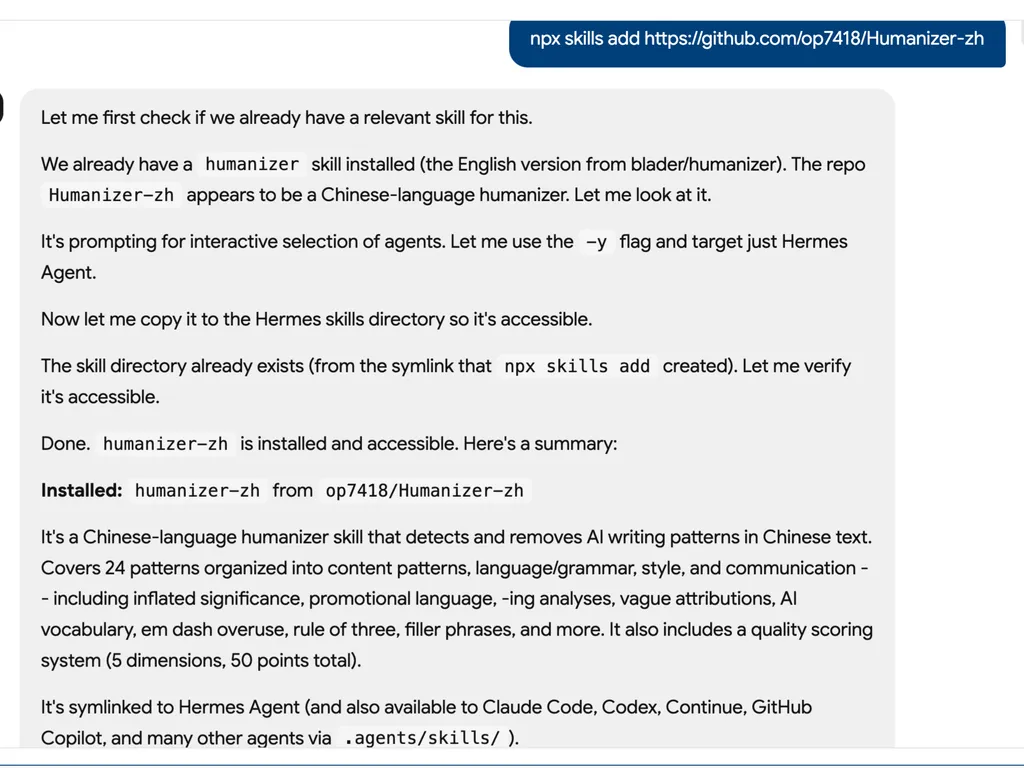
npx skills add https://github.com/op7418/Humanizer-zh.git
This is the simplest installation method, automatically installing the skill to the correct directory.
Method 2: Clone via Git
# Clone to Claude Code's skills directory
git clone https://github.com/op7418/Humanizer-zh.git ~/.claude/skills/humanizer-zh
Method 3: Manual Installation
-
Download this project's ZIP file or clone to local
-
Copy the
Humanizer-zhfolder to Claude Code's skills directory:- macOS/Linux:
~/.claude/skills/ - Windows:
%USERPROFILE%\.claude\skills\
- macOS/Linux:
-
Ensure the folder structure is as follows:
~/.claude/skills/humanizer-zh/
├── SKILL.md       # Skill definition file (Chinese version)
└── README.md      # Documentation
Verify Installation
After restarting Claude Code or reloading skills, enter in the conversation:
/humanizer-zh
If installed successfully, the skill will be activated.
Usage
Basic Usage
In Claude Code, you can use Humanizer in the following ways:
1. Invoke the skill directly
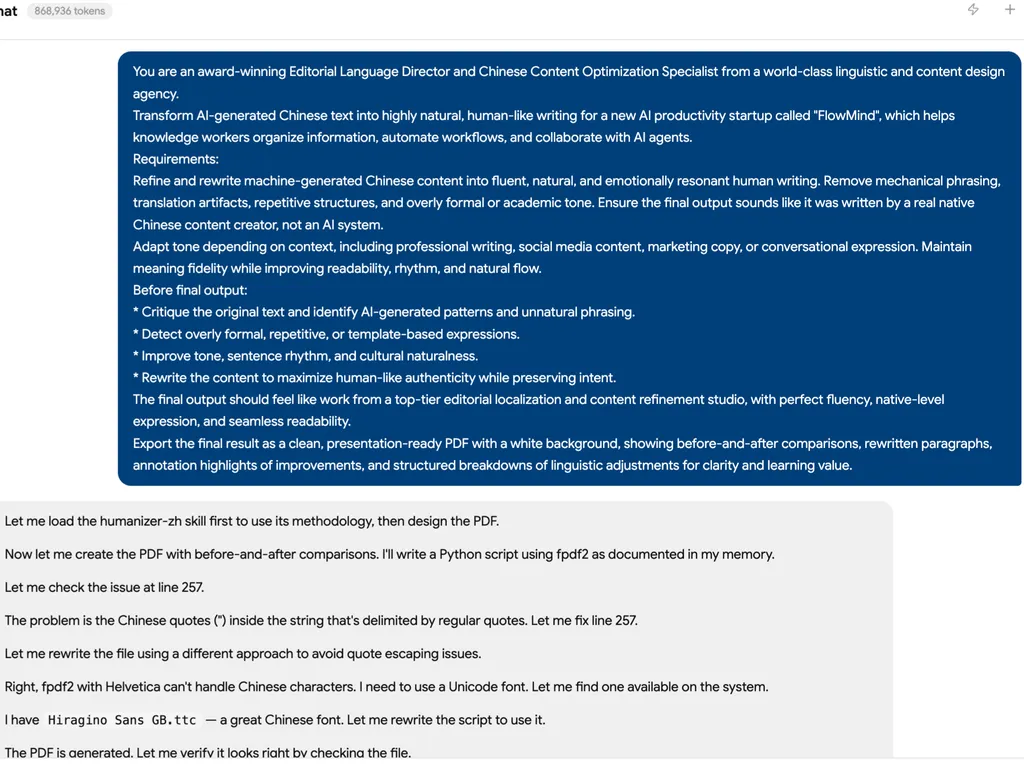
/humanizer-zh Please humanize the following text:

[Paste your AI-generated text]
2. Use in conversation
Please use humanizer to rewrite this passage to make it more natural:

This project serves as proof of our team's commitment to innovation. Additionally, it showcases our key role in the ever-evolving technological landscape.
3. Process file content
/humanizer-zh Please humanize the content in article.md
Usage Scenario Examples
Scenario 1: Rewrite marketing copy
Input:
/humanizer-zh
Located in the picturesque center of Hangzhou, this café boasts rich cultural heritage and breathtaking decor. It serves as the focal point of the city's coffee culture, offering customers a seamless, intuitive, and vibrant experience.
Output Example:
This café has been in downtown Hangzhou for three years, known for its pour-over coffee and renovated old building space.
Scenario 2: Rewrite academic abstract
Input:
/humanizer-zh
This study delves into the critical role of machine learning in medical diagnosis, highlighting its importance in the ever-evolving healthcare landscape. Additionally, it lays a solid foundation for the future development of this field.
Output Example:
This study analyzed the application of machine learning in medical diagnosis, focusing on early lung cancer screening. It used 5,000 medical records from 2019–2023.
Scenario 3: Rewrite blog posts
Input:
/humanizer-zh
Artificial intelligence is not just a technology; it is a revolution in the way we think about the future. Industry experts believe it will have a lasting impact on society as a whole.
Output Example:
I keep thinking about how AI will change the way we work. Last week, chatting with a few friends in product development, some were excited, some worried about job loss—the truth probably lies somewhere boring in between.
Detectable AI Writing Patterns
This tool can identify and fix 24 types of AI writing traces, divided into four categories:
📝 Content Patterns (6 types)
- Overemphasis on significance, legacy, and broader trends
- Overemphasis on popularity and media coverage
- Superficial analysis ending with -ing
- Promotional and advertising language
- Vague attribution and ambiguous wording
- Token "challenges and future outlook" sections
🔤 Language and Grammar Patterns (6 types)
- Overused "AI vocabulary"
- Avoidance of "to be" (copula avoidance)
- Negative parallelism
- Overuse of the rule of three
- Deliberate synonym swapping (synonym cycling)
- False scope
🎨 Style Patterns (6 types)
- Overuse of dashes
- Overuse of bold
- Inline heading vertical lists
- Title case in headings
- Emojis
- Curly quotes
💬 Communication Patterns and Filler Words (6 types)
- Collaborative communication traces
- Knowledge cutoff disclaimers
- Ingratiating / sycophantic tone
- Filler phrases
- Over-qualification
- Generic positive conclusions
File Description
SKILL.md- Chinese version skill definition fileREADME.md- This documentation
Note: For the English original, see blader/humanizer
Manual Usage Method
Basic Workflow
- Identify AI patterns - Scan text against the 24 patterns listed in
SKILL.md - Rewrite problematic segments - Replace AI traces with natural expressions
- Preserve core meaning - Ensure information completeness
- Maintain appropriate tone - Match the intended style of the text
- Inject authentic personality - Give the text a "human touch"
Key Principles
✨ Not just "clean," but "vivid"
Avoiding AI patterns is just the foundation; good writing needs an authentic human voice:
- Have an opinion - Don't just report facts; react to them
- Vary rhythm - Mix long and short sentences
- Acknowledge complexity - Real people have mixed feelings
- Use "I" appropriately - First person is a sign of honesty
- Allow some messiness - Perfect structure can feel mechanical
- Be specific about feelings - Replace abstract summaries with concrete details
Example Comparison
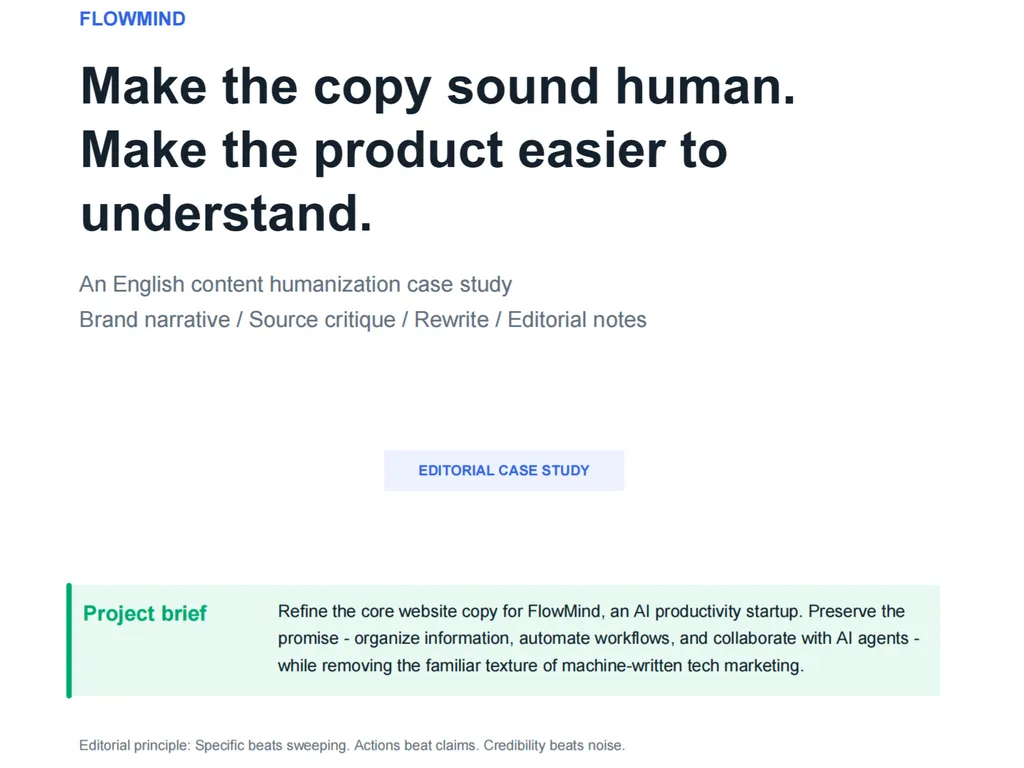
Before rewriting (AI flavor):
The new software update serves as proof of the company's commitment to innovation. Additionally, it provides a seamless, intuitive, and powerful user experience—ensuring users can efficiently achieve their goals. This is not just an update, but a revolution in the way we think about productivity.
After rewriting (humanized):
The software update added batch processing, keyboard shortcuts, and offline mode. Early feedback from test users is positive—most report faster task completion.
Changes:
- Removed exaggerated symbolism ("serves as proof")
- Removed AI vocabulary ("additionally," "seamless")
- Removed rule of three ("seamless, intuitive, and powerful")
- Removed negative parallelism ("not just... but...")
- Added specific features and real feedback
Common AI Vocabulary Warning List
The following words appear with unusually high frequency in AI-generated text:
- Additionally, crucial, delve into, emphasize
- Enduring, enhance, foster, gain
- Highlight, interplay, complex/complexity
- Landscape (abstract noun), pivotal, showcase
- Tapestry (abstract noun), testament, underscore
- Valuable, vibrant
Contributing
If you find translation issues or want to improve the documentation, please submit an Issue or Pull Request.
Chinese Context Specifics
During translation and adaptation, we considered the characteristics of Chinese writing:
- Some English patterns manifest differently in Chinese (e.g., title case issues)
- Added examples suitable for Chinese context
- Adjusted some expressions to align with Chinese conventions
References
- Wikipedia: Signs of AI writing - Original guide source
- WikiProject AI Cleanup - Wikipedia AI Cleanup Project
- blader/humanizer - Original English project
- hardikpandya/stop-slop - Inspiration for the utility sections
License
This translation project follows the license of the original project. The core content is based on observations and summaries from the Wikipedia community.
Tip: This tool is not designed to "deceive" AI detectors but to genuinely improve writing quality. The best way to "de-AI" text is to give it authentic human thought and voice.