NanoSkill
submit your skill

Go-to-Market Strategy Skill

byphuryn26KGitHub starsGitHub

Create a complete go-to-market strategy with recommended channels, messaging, launch KPIs, and a 90-day roadmap. Start free in seconds.

strategySecurity scan passed
Result preview

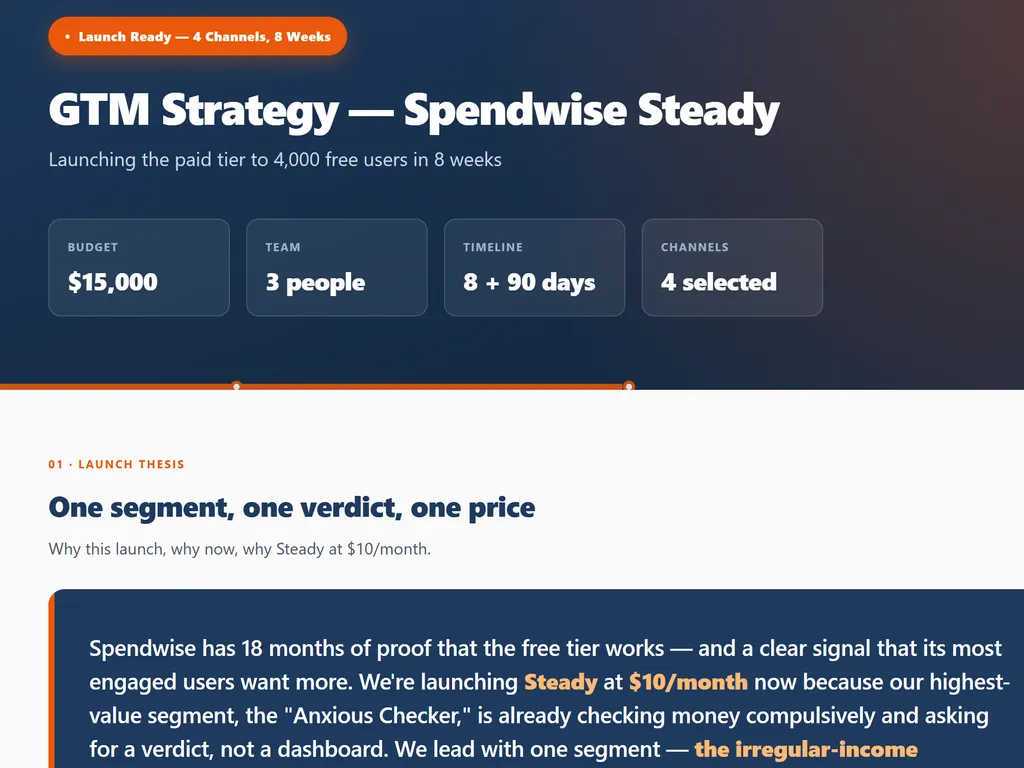
Full Demo

See four focused channels, six rejected, a 90-day timeline with gates, and a failure threshold.

Get started

Run Your First Task

  1. the step of go-to-market strategy skill
    01

    Install

    Add the GTM Strategy Skill to your AI agent.

  2. the step of go-to-market strategy skill
    02

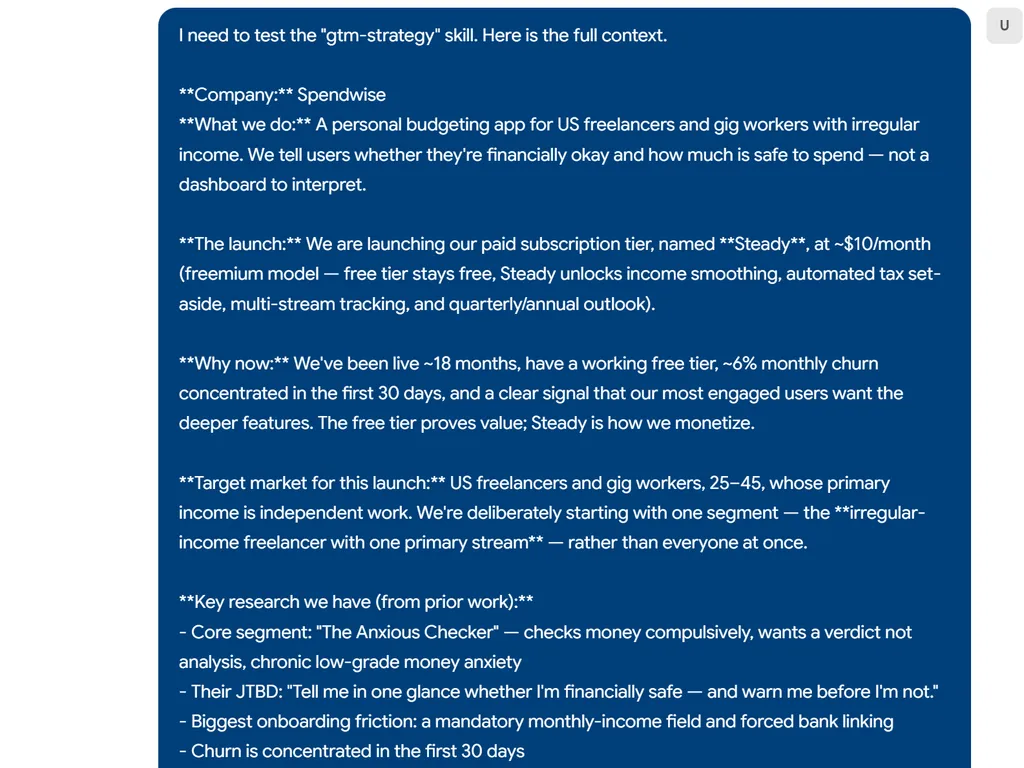
    Share Product & Constraints

    Give it your launch, budget, team size, and target segment.

  3. the step of go-to-market strategy skill
    03

    Get Your Launch Plan

    Receive focused channels, messaging, KPIs, a gated timeline, and budget split.

Install command

$ npx skills add https://github.com/phuryn/pm-skills/tree/main/pm-go-to-market/skills/gtm-strategy

Installation signals

Installation activity

About

Go-to-market strategy can mean the difference between a product that launches with momentum and one that gets ignored. This skill helps product managers, founders, and launch teams create a structured go-to-market strategy covering marketing channels, audience-specific messaging, measurable KPIs, and a phased launch timeline.

The skill applies Product Compass GTM methodology to focus on market selection, channel fit, and message-market fit. It guides you through research intake, channel evaluation, messaging development, success metrics definition, and launch planning, then produces a structured strategy document with recommended channels, KPI targets, risk mitigation, and a 90-day execution roadmap.

Use it when planning a product launch, entering a new market, or preparing a product go-live roadmap. The process encourages validation through customer interviews, focusing on a few excellent channels, establishing baseline metrics before launch, and building feedback loops for optimization.

Key features

What makes it powerful

  • Complete GTM plan creation

    Build a structured go-to-market strategy with recommended marketing channels, positioning, launch milestones, and a 90-day execution roadmap.

  • Channel and messaging fit

    Evaluate digital, content, sales, community, and product-led channels, then create audience-specific messaging with differentiators and proof points.

  • Measurable launch KPIs

    Define awareness, engagement, conversion, revenue, and market metrics with baseline guidance and optimization cadence.

  • Product Compass methodology

    Apply market selection, channel fit, and message-market fit principles to focus on sustainable product growth.

  • Phased launch execution

    Turn strategy into pre-launch, launch-day, and post-launch activities with go/no-go decision points and feedback loops.

Use cases

When to reach for it

  • Plan a product launch

    Product managers and founders can create a phased go-to-market strategy with channel recommendations, messaging, and a launch timeline.

  • Enter a new market

    Define the target segment, validate assumptions, and align positioning and metrics before expanding.

  • Develop product-market fit

    Use research inputs and the Product Compass GTM methodology to refine value proposition and message-market fit.

  • Create a 90-day execution roadmap

    Turn strategy into pre-launch, launch-day, and post-launch actions with measurable KPI targets.

SKILL.md

GTM Strategy

Overview

Create a comprehensive go-to-market strategy for a product launch. This skill covers marketing channels, messaging development, success metrics definition, and launch planning.

When to Use

  • Planning a product launch
  • Creating a GTM plan from scratch
  • Defining a launch strategy for a new market
  • Developing product-to-market fit strategy
  • Preparing a product go-live roadmap

How It Works

Step 1: Gather Research Data

The system will help you load and analyze early research about your product and target market. Provide:

  • Product description and key features
  • Target market segment details
  • Market research or validation data
  • Competitive landscape information
  • Any available customer interviews or survey data

Step 2: Define Marketing Channels

Evaluate which channels best reach your target audience:

  • Digital marketing channels (paid search, social media, display)
  • Content and inbound channels (blog, SEO, thought leadership)
  • Sales and outbound channels (direct outreach, partnerships)
  • Community and grassroots channels
  • Product-led and viral channels

Step 3: Develop Messaging

Create audience-specific messaging that resonates:

  • Core value proposition for target segment
  • Key differentiators and competitive advantages
  • Pain point validation and solution mapping
  • Proof points and social proof strategies
  • Channel-specific messaging variations

Step 4: Define Success Metrics

Establish measurable KPIs to track launch success:

  • Awareness metrics (impressions, reach, brand recall)
  • Engagement metrics (CTR, cost per engagement, time on site)
  • Conversion metrics (signups, demos requested, trials started)
  • Revenue metrics (MRR, customer acquisition cost, lifetime value)
  • Market metrics (market share, segment penetration)

Step 5: Create Launch Plan

Build a phased launch timeline:

  • Pre-launch preparation (messaging, channels, timeline)
  • Launch day activities and announcements
  • Post-launch momentum (content, partnerships, communities)
  • Measurement and optimization cadence
  • Success criteria and go/no-go decision points

Input Format

Use $ARGUMENTS to pass:

  • Product name and description
  • Target market segment
  • Research data or file path
  • Launch timeline and constraints
  • Budget or resource limitations

Output

A structured GTM strategy document including:

  • Recommended marketing channels with justification
  • Channel-specific messaging and positioning
  • Launch timeline with key milestones
  • KPI targets and measurement framework
  • Risk mitigation strategies
  • 90-day execution roadmap

Framework

This skill applies Product Compass GTM strategy methodology, focusing on market selection, channel fit, and message-market fit for sustainable product growth.

Tips

  • Start with your most confident customer segment
  • Validate assumptions through customer interviews before full launch
  • Focus on a few channels excellently rather than many channels poorly
  • Establish baseline metrics before launch to measure impact
  • Plan for feedback loops and optimization

Further Reading

  • 5 GTM Principles You Should Know as a PM
  • OpenAI’s Product Leader Shares 3-Layer Distribution Framework To Win Mind & Market Share in the AI World
  • Product-Led Growth 101, Part 1/2
  • How to Design a Value Proposition Customers Can't Resist?
  • How to Achieve Product-Market Fit? Part I: Market and Value Proposition

FAQ