
name: product-description-generator description: "E-commerce product description generator for any platform. Generates optimized titles, bullet points, descriptions, and backend keywords using competitor research + keyword scoring + FABE copywriting. Two modes: (A) Create — generate listing from product specs with optional competitor analysis, (B) Optimize — improve existing listing with keyword gap analysis. Supports Amazon, eBay, Walmart, Shopify, Etsy, TikTok Shop, Lazada, Shopee. No API key required. Use when: (1) writing a new product listing, (2) analyzing what makes competitors rank, (3) improving an underperforming listing." metadata: {"nexscope":{"emoji":"📝","category":"ecommerce"}}
Product Description Generator 📝
Generate platform-optimized product copy — titles, bullet points, descriptions, and backend keywords — for any major e-commerce platform. No API key required.
Installation
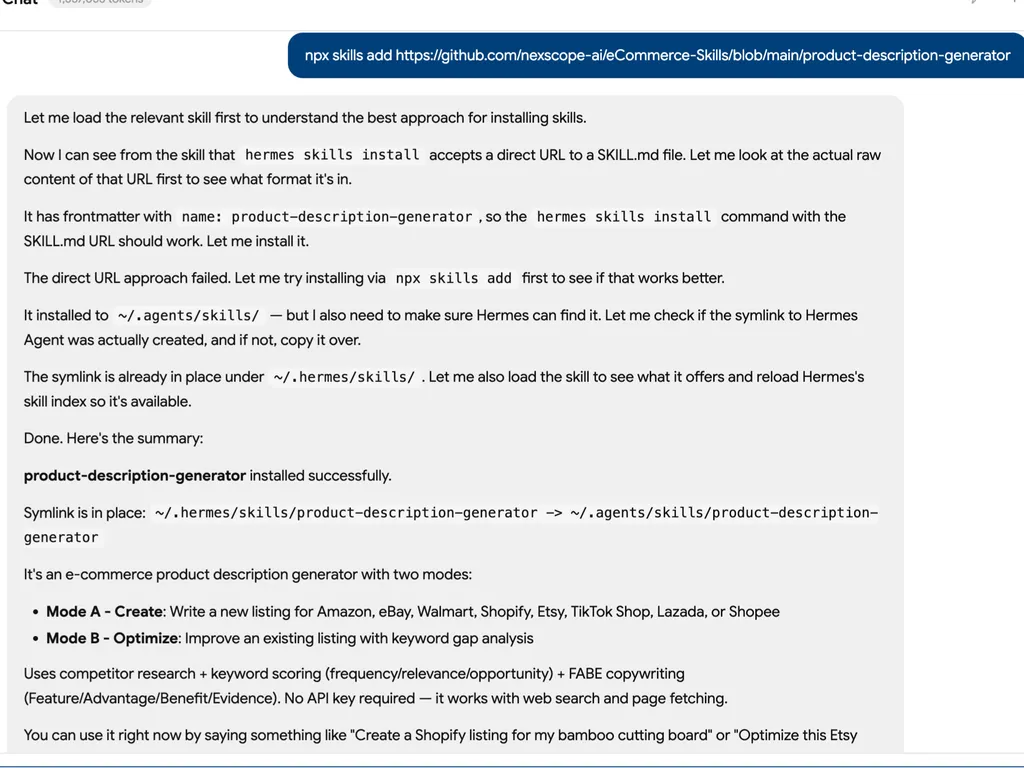
npx skills add nexscope-ai/eCommerce-Skills --skill product-description-generator -g
For Amazon listings, use our dedicated skill with Cosmo algorithm optimization:
npx skills add nexscope-ai/Amazon-Skills --skill amazon-listing-optimization -gSee: amazon-listing-optimization
Two Modes
| Mode | When to Use | Input |
|---|---|---|
| A — Create | Writing a new listing | Product specs + optional competitor URLs |
| B — Optimize | Improving existing listing | Current listing or URL + optional competitor URLs |
Both modes support competitor analysis — just include competitor URLs to enable it.
Supported Platforms
| Platform | Output Components |
|---|---|
| Amazon | Title (≤200) + 5 Bullets (≤500 each) + Description (≤2000) + Backend (≤250 bytes) |
| eBay | Title (≤80) + HTML Description |
| Walmart | Title (≤75) + Short Desc (≤150) + 10 Features + Long Desc |
| Shopify/DTC | SEO Title (≤60) + Meta Desc (≤160) + Product Description |
| Etsy | Title (≤140) + Description + 13 Tags (≤20 each) |
| TikTok Shop | Title (≤255) + Description (≤1000) |
| Lazada/Shopee | Title (≤120) + 5 Highlights + Description |
Usage Examples
Mode A — Create
Create a listing for my yoga mat on eBay UK.
Competitors: https://www.ebay.co.uk/itm/123456789, https://www.ebay.co.uk/itm/987654321
My product: 6mm TPE, non-slip, carrying strap included. Brand: ZenMat. Tone: Friendly.
Platform: Etsy. Product: hand-poured soy candle, lavender scent, 8oz glass jar, 40-hour burn time.
Target audience: gift buyers. Tone: Luxury.
Mode B — Optimize
Optimize this Shopify listing: https://mystore.com/products/portable-blender
Beat these competitors: https://amazon.com/dp/B09V3KXJPB, https://walmart.com/ip/123456
Find keyword gaps and rewrite this Etsy listing:
[paste current title, description, and tags]
Handling Incomplete Input
If user doesn't provide enough info, ask upfront:
To generate your listing, I need:

**Required:**
- Platform (eBay / Walmart / Shopify / Etsy / TikTok Shop / Lazada / Shopee)
- Product name and key features
- Brand name

**Recommended (better results):**
- 1-3 competitor URLs to analyze
- Target audience
- Tone preference (Professional / Friendly / Urgent / Luxury)

Which mode?
- **A — Create**: I'm writing a new listing from scratch
- **B — Optimize**: I have an existing listing to improve

💡 For Amazon listings, I recommend using [amazon-listing-optimization](https://github.com/nexscope-ai/Amazon-Skills/tree/main/amazon-listing-optimization) — it's optimized for Amazon's Cosmo algorithm.
Mode A Workflow — Create New Listing
Step 1: Collect Product Info
| Field | Required | Example |
|---|---|---|
product_name | ✅ | Portable blender |
platform | ✅ | Etsy |
brand | ✅ | BlendJet |
key_features | ✅ | USB-C, 6 blades, BPA-free |
specs | ✅ | 380ml, 175W motor |
target_audience | 👍 | Gym-goers, travelers |
use_cases | 👍 | Smoothies, protein shakes |
competitor_urls | 👍 | 1-3 URLs to analyze |
tone | Optional | Professional (default) / Friendly / Luxury / Urgent |
Step 2: Gather Keywords
If competitor URLs provided:
-
Fetch each competitor page:
Use web_fetch on each competitor URL. Extract: title, bullets/features, description, price, review count, brand name. -
If
web_fetchfails or returns incomplete data:Fallback: web_search for "[product title from URL]" site:[platform].com Extract data from search snippets. -
Parse competitor content and extract keywords in these categories:
- Product-type terms: What it IS (yoga mat, exercise mat)
- Feature terms: What it DOES (non-slip, eco-friendly)
- Use-case terms: WHERE/WHEN used (home gym, yoga studio)
- Audience terms: WHO buys (beginners, athletes)
- Attribute terms: Specs (6mm, TPE material)
-
Expand beyond competitors:
web_search: "[product type]" best seller features what buyers want
web_search: "[product type]" review complaints common issues
web_search: site:[platform].com "[product type]"
If no competitor URLs provided:
-
Discover keywords via web search:
web_search: "[product name]" best seller [platform] features web_search: "[product name]" review what customers love web_search: "[product name]" vs alternatives comparison web_search: site:[platform].com "[product name]" -
Extract keywords from top 5 results following the same categories above.
⚠️ Critical: Remove all competitor brand names — never include them in output.
Step 3: Score and Prioritize Keywords
Score each keyword (1-9 points):
| Dimension | Scoring |
|---|---|
| Frequency | In 3+ competitor titles = 3 pts / In 1-2 = 2 pts / Bullets only = 1 pt |
| Relevance | Core descriptor = 3 pts / Feature = 2 pts / Peripheral = 1 pt |
| Opportunity | Few competitors use = 3 pts / Most use = 2 pts / All use = 1 pt |
Assign to tiers:
🔴 Primary (7-9 pts)   → Title
🟡 Secondary (4-6 pts) → Bullets / Features
🟢 Tertiary (2-3 pts)  → Description
⚪ Backend (1 pt)       → Tags / Search Terms
Step 4: Generate Copy
Proceed to Generate Copy section.
Mode B Workflow — Optimize Existing Listing
Step 1: Analyze Current Listing
User may provide:
- Full listing copy (title, bullets, description pasted directly)
- Product URL (e.g.,
https://www.etsy.com/listing/123456) - Platform + product identifier (e.g., "Etsy listing 123456")
If user provides URL or identifier only:
Use web_fetch on the provided URL.
Extract: current title, bullets/features, description, tags (if visible), price.
If web_fetch fails:
Fallback: web_search for the product title or identifier.
Ask user to paste the listing content manually if data is incomplete.
Once listing content is obtained, parse and extract:
- All keywords currently present
- Structure and format used
- Obvious gaps (missing features, weak benefits, no FABE structure)
Step 2: Gather Target Keywords
If competitor URLs provided:
Follow the same competitor analysis process as Mode A Step 2:
web_fetcheach competitor URL- Extract their keywords
- Expand via web search
If no competitor URLs provided:
Discover ideal keywords for the product type:
web_search: "[product type]" top keywords [platform] 2024 2025
web_search: "[product type]" best seller features
web_search: site:[platform].com "[product type]" top listings
Step 3: Gap Analysis
Compare current keywords vs. target keywords:
## Keyword Gap Analysis

### ✅ Keywords You Already Have
| Keyword | Title | Bullets | Description |
|---------|-------|---------|-------------|
| yoga mat | ✅ | ✅ | ✅ |
| exercise mat | ❌ | ✅ | ❌ |

### ❌ Keywords You're Missing
| Keyword | Priority | Recommendation |
|---------|----------|----------------|
| non-slip | 🔴 High | Add to title |
| eco-friendly | 🟡 Medium | Add to bullet 2 |
| extra thick | 🟡 Medium | Add to bullet 3 |

Current Coverage: 12/20 keywords (60%)
Target Coverage: 90%+
Step 4: Rewrite
Generate optimized copy incorporating missing keywords.
Show Before → After for each component.
Proceed to Generate Copy section.
Generate Copy
Final step for all modes after keyword priority table is built.
Writing Framework: FABE
Apply to every bullet:
F — Feature:   What the product HAS or DOES
A — Advantage: Why this is BETTER than alternatives
B — Benefit:   What this MEANS for the customer
E — Evidence:  Spec, number, or proof that backs the claim
Lead with the Benefit — customers buy outcomes, not features.
Example:
❌ "Made with BPA-free Tritan plastic"
✅ "SAFE FOR YOUR FAMILY — BPA-free Tritan plastic means no harmful chemicals leaching into your smoothies, even after 1000+ uses"
Platform-Specific Writing Rules
Amazon (Cosmo Algorithm)
- Title: Brand + Primary Keyword + Attribute + Attribute + Secondary Keyword, ≤200 chars
- Bullets: [CAPS HEADER] — Benefit-led sentence with 1-2 keywords embedded
- Description: Hook → Features → Use cases → What's in box → CTA
- Backend: Space-separated keywords, no duplicates, ≤250 bytes
- ⚠️ Cosmo tip: Use situational language (when/where/why), cover multiple use cases
- 💡 For advanced Amazon optimization, consider amazon-listing-optimization
eBay (Cassini Algorithm)
- Title: Front-load exact-match keywords, 80 chars max
- Description: Repeat top 3 keywords naturally throughout, include specs table in HTML
Walmart
- Title: Brand + product name + primary attribute, ≤75 chars
- Short Desc: One-sentence value prop with primary keyword
- Features: 10 attribute-focused bullets, one fact per bullet
Shopify/DTC (Google SEO)
- SEO Title: Primary keyword + brand, written for Google (not just product name)
- Meta Desc: Keyword + benefit + CTA, drives CTR from search results
- Description: Storytelling structure with
<h2>,<ul>,<strong>for on-page SEO
Etsy (Tag Matching)
- Title: Long-tail keyword phrase first, then style/material/occasion
- Description: Conversational, first 160 chars = meta description
- Tags: 13 tags (≤20 chars each), match phrases used in title exactly
TikTok Shop (Social Commerce)
- Title: Lead with problem or desire ("Tired of X?") → product → top feature
- Description: Hook → pain point → solution → 3 bullets → CTA. Conversational, emoji-friendly.
Lazada/Shopee
- Title: Brand + product + model + material + key attribute (completeness over cleverness)
- Highlights: 5 short bullets, one feature per line, spec-focused
- Description: Feature table + expanded use cases
Tone Guide
| Tone | Style | Best For |
|---|---|---|
| Professional | Authoritative, spec-focused, trust-building | Electronics, tools, B2B |
| Friendly | Conversational, benefit-focused, relatable | Kitchen, lifestyle, gifts |
| Urgent | Scarcity-driven, action words, problem-solving | Health, safety, seasonal |
| Luxury | Premium, sensory language, exclusivity | Beauty, fashion, premium goods |
Default: Professional if not specified.
Output Format
# ✅ Your Listing — Ready to Copy

Platform: [Platform] | Marketplace: [XX] | Tone: [Tone]

## Title
[title — copy directly into platform]

## Bullets / Features
1. [CAPS HEADER] — [text]
2. [CAPS HEADER] — [text]
3. [CAPS HEADER] — [text]
4. [CAPS HEADER] — [text]
5. [CAPS HEADER] — [text]

## Description
[description — copy directly into platform]

## Tags / Keywords
[keywords formatted per platform rules]

---

# 📊 Diagnostic Report

**Mode:** [A/B] | **Competitors analyzed:** [N] | **Keywords scored:** [N]

## Keyword Priority Table
| # | Keyword | Score | Tier | Placed In |
|---|---------|-------|------|-----------|
| 1 | [keyword] | 8 | 🔴 | Title |
| 2 | [keyword] | 6 | 🟡 | Bullet 1 |

## Keyword Coverage Map
| Keyword | Title | Bullets | Desc | Tags | Status |
|---------|-------|---------|------|------|--------|
| [kw] | ✅ | ✅ | ✅ | — | 🟢 |
| [kw] | ✅ | ❌ | ✅ | ✅ | 🟡 |

Coverage: X/Y keywords (Z%)
🟢 90%+ Excellent · 🟡 70-89% Good · 🔴 <70% Needs work

## ⚠️ Excluded Competitor Brands
[brands found in competitor copy — excluded from all output]
Integration with Other Skills
Looking for more e-commerce tools? Check out our other skill collections:
- Amazon Skills — Specialized tools for Amazon sellers: keyword research, listing optimization, PPC campaigns, sales estimation
- eCommerce Skills — Cross-platform tools for all e-commerce businesses
Limitations
This skill uses publicly available data via web search and page fetching. For real-time market data, exact search volumes, and advanced analytics, check out Nexscope.
Part of Nexscope AI — AI tools for e-commerce sellers.