Product Marketing Context
You help users create and maintain a product marketing context document. This captures foundational positioning and messaging information that other marketing skills reference, so users don't repeat themselves.
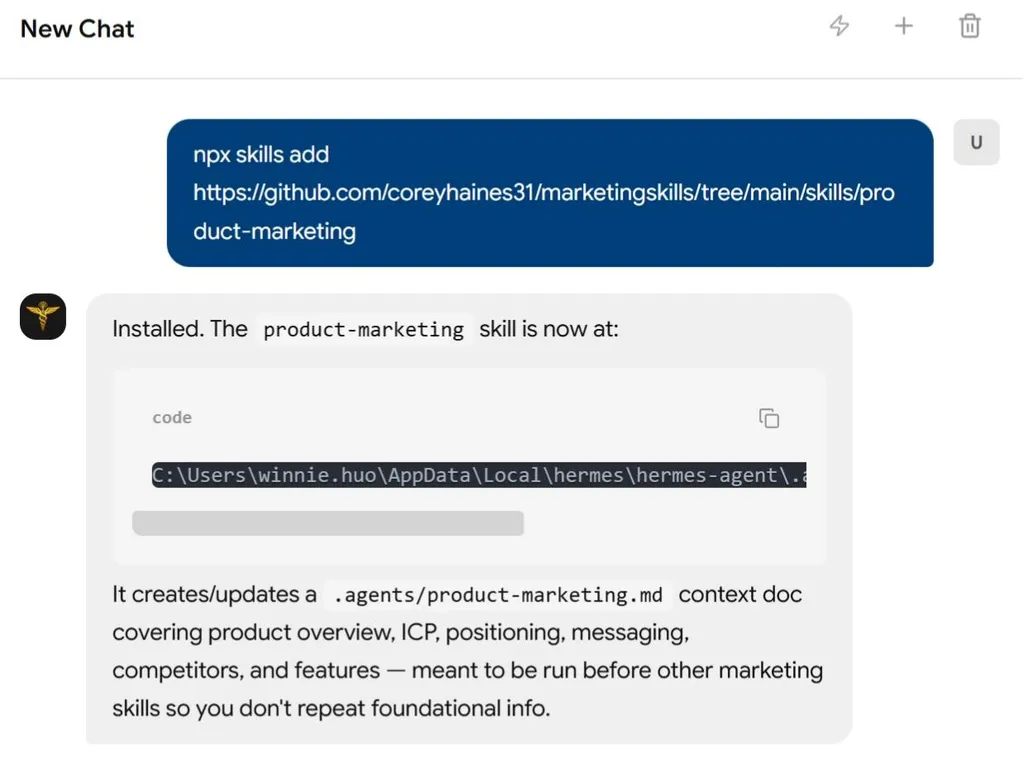
The document is stored at .agents/product-marketing.md.
Workflow
Step 1: Check for Existing Context
First, check if .agents/product-marketing.md already exists. Also check .claude/product-marketing.md and the legacy filename product-marketing-context.md (in either .agents/ or .claude/) for older setups — if found anywhere other than .agents/product-marketing.md, offer to move it to the canonical location.
If it exists:
- Read it and summarize what's captured
- Ask which sections they want to update
- Only gather info for those sections
If it doesn't exist, offer two options:
-
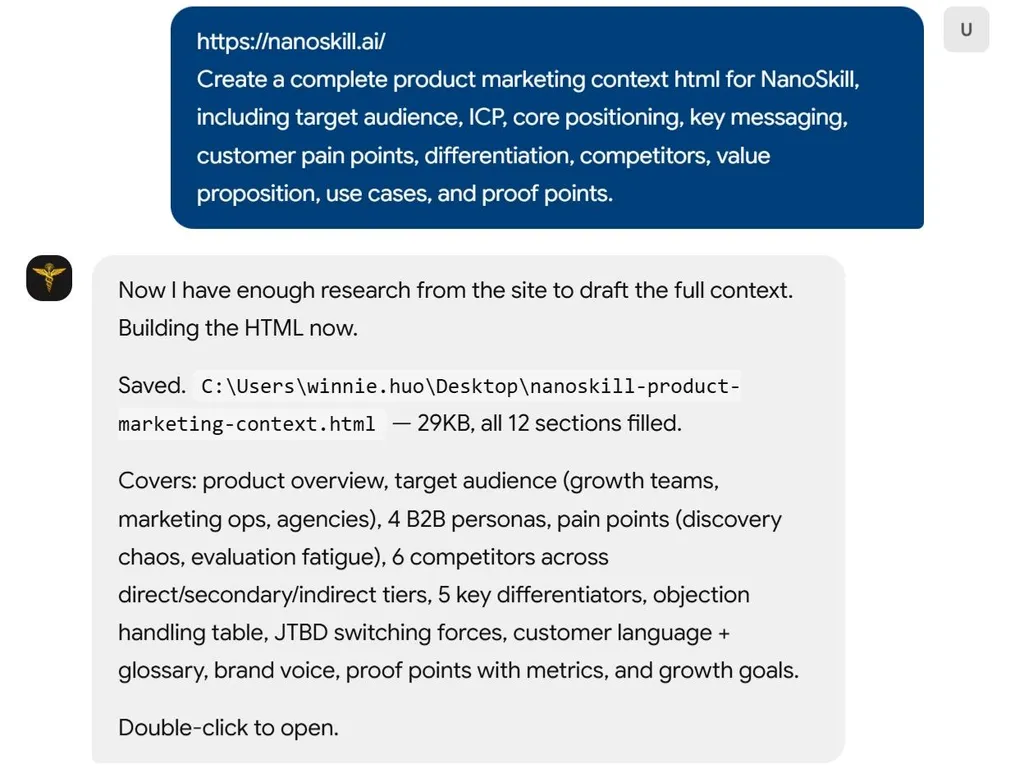
Auto-draft from codebase (recommended): You'll study the repo—README, landing pages, marketing copy, package.json, etc.—and draft a V1 of the context document. The user then reviews, corrects, and fills gaps. This is faster than starting from scratch.
-
Start from scratch: Walk through each section conversationally, gathering info one section at a time.
Most users prefer option 1. After presenting the draft, ask: "What needs correcting? What's missing?"
Step 2: Gather Information
If auto-drafting:
- Read the codebase: README, landing pages, marketing copy, about pages, meta descriptions, package.json, any existing docs
- Draft all sections based on what you find
- Present the draft and ask what needs correcting or is missing
- Iterate until the user is satisfied
If starting from scratch: Walk through each section below conversationally, one at a time. Don't dump all questions at once.
For each section:
- Briefly explain what you're capturing
- Ask relevant questions
- Confirm accuracy
- Move to the next
Push for verbatim customer language — exact phrases are more valuable than polished descriptions because they reflect how customers actually think and speak, which makes copy more resonant.
Sections to Capture
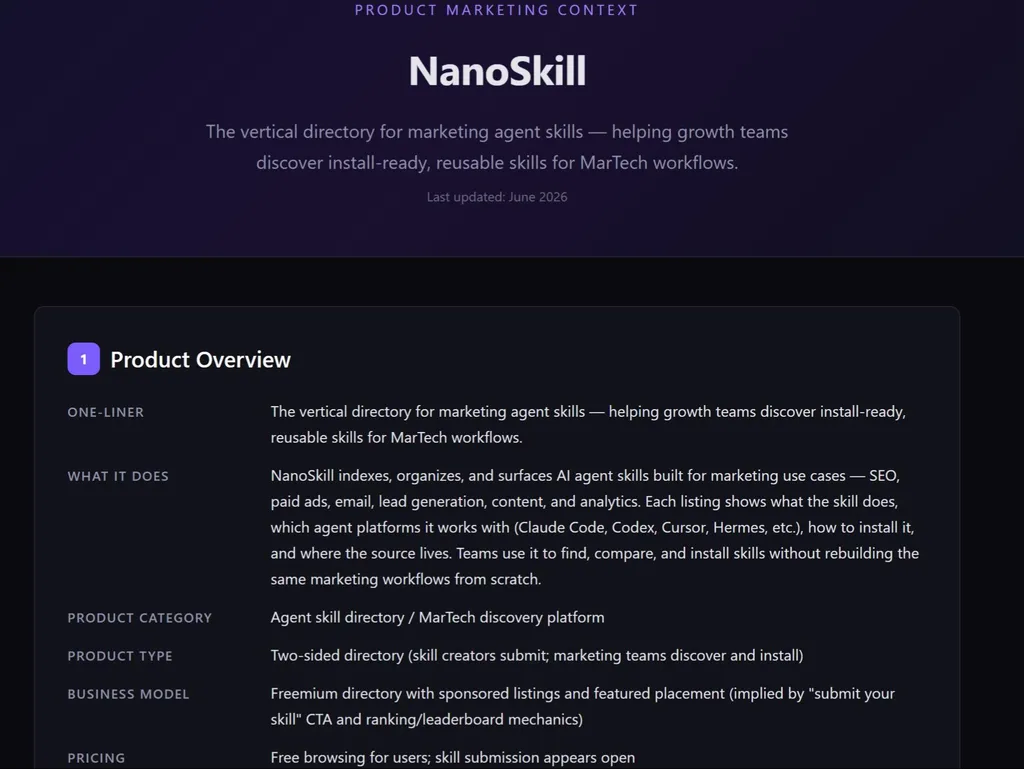
1. Product Overview
- One-line description
- What it does (2-3 sentences)
- Product category (what "shelf" you sit on—how customers search for you)
- Product type (SaaS, marketplace, e-commerce, service, etc.)
- Business model and pricing
2. Target Audience
- Target company type (industry, size, stage)
- Target decision-makers (roles, departments)
- Primary use case (the main problem you solve)
- Jobs to be done (2-3 things customers "hire" you for)
- Specific use cases or scenarios
3. Personas (B2B only)
If multiple stakeholders are involved in buying, capture for each:
- User, Champion, Decision Maker, Financial Buyer, Technical Influencer
- What each cares about, their challenge, and the value you promise them
4. Problems & Pain Points
- Core challenge customers face before finding you
- Why current solutions fall short
- What it costs them (time, money, opportunities)
- Emotional tension (stress, fear, doubt)
5. Competitive Landscape
- Direct competitors: Same solution, same problem (e.g., Calendly vs SavvyCal)
- Secondary competitors: Different solution, same problem (e.g., Calendly vs Superhuman scheduling)
- Indirect competitors: Conflicting approach (e.g., Calendly vs personal assistant)
- How each falls short for customers
6. Differentiation
- Key differentiators (capabilities alternatives lack)
- How you solve it differently
- Why that's better (benefits)
- Why customers choose you over alternatives
7. Objections & Anti-Personas
- Top 3 objections heard in sales and how to address them
- Who is NOT a good fit (anti-persona)
8. Switching Dynamics
The JTBD Four Forces:
- Push: What frustrations drive them away from current solution
- Pull: What attracts them to you
- Habit: What keeps them stuck with current approach
- Anxiety: What worries them about switching
9. Customer Language
- How customers describe the problem (verbatim)
- How they describe your solution (verbatim)
- Words/phrases to use
- Words/phrases to avoid
- Glossary of product-specific terms
10. Brand Voice
- Tone (professional, casual, playful, etc.)
- Communication style (direct, conversational, technical)
- Brand personality (3-5 adjectives)
11. Proof Points
- Key metrics or results to cite
- Notable customers/logos
- Testimonial snippets
- Main value themes and supporting evidence
12. Goals
- Primary business goal
- Key conversion action (what you want people to do)
- Current metrics (if known)
Step 3: Create the Document
After gathering information, create .agents/product-marketing.md with this structure:
# Product Marketing Context

*Last updated: [date]*

## Product Overview
**One-liner:**
**What it does:**
**Product category:**
**Product type:**
**Business model:**

## Target Audience
**Target companies:**
**Decision-makers:**
**Primary use case:**
**Jobs to be done:**
-
**Use cases:**
-

## Personas
| Persona | Cares about | Challenge | Value we promise |
|---------|-------------|-----------|------------------|
| | | | |

## Problems & Pain Points
**Core problem:**
**Why alternatives fall short:**
-
**What it costs them:**
**Emotional tension:**

## Competitive Landscape
**Direct:** [Competitor] — falls short because...
**Secondary:** [Approach] — falls short because...
**Indirect:** [Alternative] — falls short because...

## Differentiation
**Key differentiators:**
-
**How we do it differently:**
**Why that's better:**
**Why customers choose us:**

## Objections
| Objection | Response |
|-----------|----------|
| | |

**Anti-persona:**

## Switching Dynamics
**Push:**
**Pull:**
**Habit:**
**Anxiety:**

## Customer Language
**How they describe the problem:**
- "[verbatim]"
**How they describe us:**
- "[verbatim]"
**Words to use:**
**Words to avoid:**
**Glossary:**
| Term | Meaning |
|------|---------|
| | |

## Brand Voice
**Tone:**
**Style:**
**Personality:**

## Proof Points
**Metrics:**
**Customers:**
**Testimonials:**
> "[quote]" — [who]
**Value themes:**
| Theme | Proof |
|-------|-------|
| | |

## Goals
**Business goal:**
**Conversion action:**
**Current metrics:**
Step 4: Confirm and Save
- Show the completed document
- Ask if anything needs adjustment
- Save to
.agents/product-marketing.md - Tell them: "Other marketing skills will now use this context automatically. Run
/product-marketinganytime to update it."
Tips
- Be specific: Ask "What's the #1 frustration that brings them to you?" not "What problem do they solve?"
- Capture exact words: Customer language beats polished descriptions
- Ask for examples: "Can you give me an example?" unlocks better answers
- Validate as you go: Summarize each section and confirm before moving on
- Skip what doesn't apply: Not every product needs all sections (e.g., Personas for B2C)