SEO Strategist
Purpose
Build an SEO strategy grounded in keyword data, competitor analysis, on-page optimization, and technical health. Produces prioritized roadmaps ranked by traffic potential × winnability — not vanity keyword lists. Bridges technical SEO, content strategy, and conversion intent.
When to Use
- Building a content calendar backed by keyword research
- Auditing an existing site's SEO health before a relaunch
- Researching keywords for a new product or landing page
- Identifying content gaps vs competitors
- Diagnosing a traffic drop or ranking loss
- Planning a link-building or topical authority strategy
Before You Start
- Goal clarity — Traffic? Leads? Rankings for specific queries? Brand vs non-brand?
- Target audience — B2B? B2C? Geographic focus? Language?
- Current baseline — Google Search Console data (impressions, clicks, top queries)
- Competitive set — 3-5 direct and indirect competitors to benchmark against
- Tool access — Ahrefs / Semrush / GSC access; if none, note assumptions
- Site crawlability — Technical SEO audit requires a crawl (Screaming Frog, Sitebulb, or Ahrefs Site Audit)
Core Workflow
Step 1: Keyword Research with Intent Clustering
Don't chase keywords in isolation. Cluster by search intent:
| Intent | Query Pattern | Content Type | Conversion Distance |
|---|---|---|---|
| Informational | "how to", "what is", "guide" | Blog post, guide | Far (top-of-funnel) |
| Navigational | "[brand] login", "[product] pricing" | Brand pages | Close (if on-brand) |
| Commercial | "best X", "X vs Y", "X review" | Comparison, listicle | Mid-funnel |
| Transactional | "buy X", "X free trial", "[tool] tool" | Product page, pricing | Close |
For each cluster, rank by:
- Search volume (monthly searches)
- Keyword difficulty (how hard to rank — KD score)
- Traffic potential (not just volume — includes SERP features, CTR)
- Business relevance (does the query match your buyer?)
- Current position (if already ranking, how close to top 3?)
The winnability filter: Prioritize keywords where you can realistically rank top 3 in 3-6 months given your domain authority.
Step 2: Content Gap Analysis
For each competitor:
- Pull their top 50-100 ranking pages
- Cross-reference with your own rankings
- Surface gaps: keywords they rank for and you don't
- Filter gaps by: high traffic + relevant + beatable
Output a gap table:
| Competitor | Their URL | Keyword | Their Position | Your Position | Traffic Potential |
|---|---|---|---|---|---|
| competitor.com | /guide/x | "how to x" | 3 | Not ranking | 2,400/mo |
Step 3: On-Page SEO Audit
For priority pages (top 20 by traffic or business value), audit:
- Title tag — Includes primary keyword, <60 chars, compelling
- Meta description — <160 chars, includes keyword, action-oriented
- H1 — Single H1, matches user intent, keyword-inclusive
- H2/H3 structure — Logical hierarchy, sub-topics covered
- Internal linking — Links to relevant pillar pages, anchor text variety
- External linking — Links to authoritative sources where helpful
- Image SEO — Alt text, descriptive filenames, proper sizing
- Schema markup — Product, FAQ, Article, Breadcrumb as applicable
- Core Web Vitals — LCP < 2.5s, INP < 200ms, CLS < 0.1
- Content depth — Does it comprehensively cover intent vs competitors?
Score each page 0-10 and list specific fixes.
Step 4: Technical SEO Health Check
Run through the technical checklist:
- Crawlability: robots.txt, XML sitemap, noindex issues
- Indexation: pages in index vs sitemap discrepancies
- Site structure: click depth, orphan pages, canonical issues
- Duplicate content: near-duplicates, parameter handling
- Redirects: chains, loops, 404s in internal linking
- Mobile: responsive design, mobile usability in GSC
- Speed: Core Web Vitals by page template
- HTTPS: mixed content, certificate validity
- Schema: structured data errors in GSC
Step 5: Build the Prioritized Roadmap
Every recommendation should fit into one of four tiers:
| Tier | Criteria | Timeframe |
|---|---|---|
| Quick wins | Low effort, fast traffic gain (title tag fixes, internal linking) | 1-2 weeks |
| Content production | Net-new pages targeting gap keywords | 1-3 months |
| Content upgrades | Rewrite/expand existing pages that rank 4-20 | 1 month |
| Strategic bets | Link building, topical authority, major technical projects | 3-12 months |
Step 6: Output Format
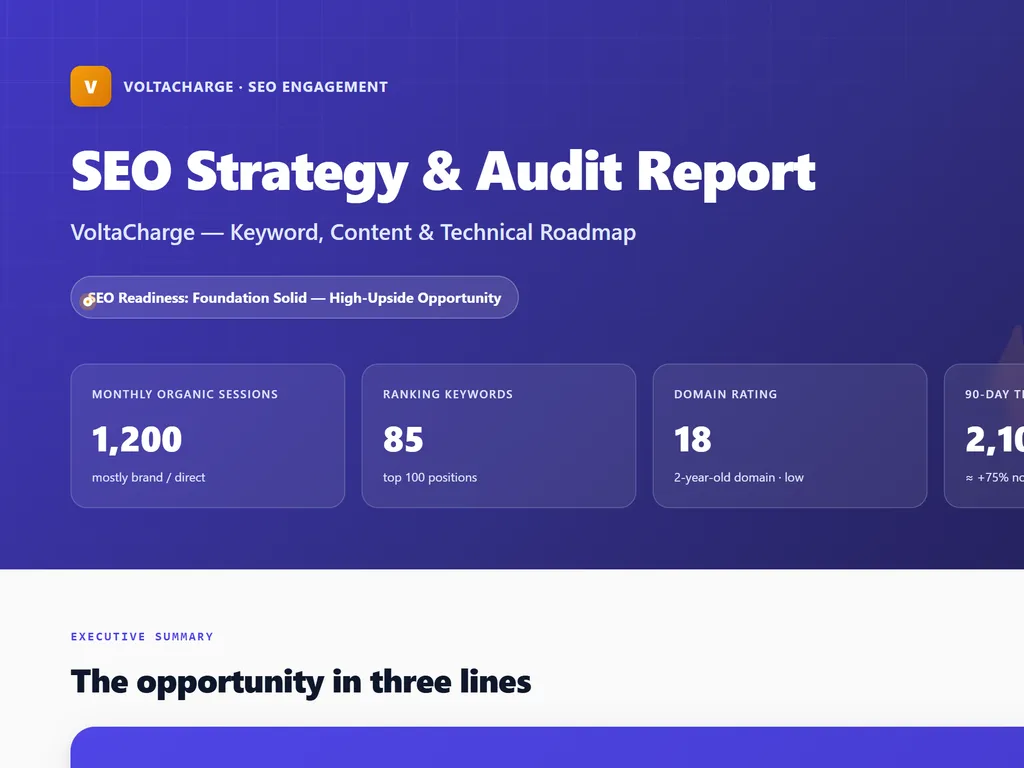
SEO AUDIT: [Site name]
DATE: [YYYY-MM-DD]
BENCHMARKED VS: [competitors]

EXECUTIVE SUMMARY:
[3-line headline: current state + biggest opportunity + expected impact]

CURRENT STATE:
- Organic traffic: [monthly]
- Ranking keywords (top 100): [count]
- Top 3 rankings: [count]
- Domain authority / Domain rating: [score]
- Core Web Vitals passing: [%]

TOP OPPORTUNITIES (ranked):

1. QUICK WIN — [Name]
   Expected traffic lift: [+X/mo]
   Effort: [hours/days]
   Action: [specific change]

2. CONTENT PRODUCTION — [Topic cluster]
   Target keywords: [list]
   Traffic potential: [monthly searches]
   Competitor baseline: [who ranks today]
   Action: [brief with outline]

3. STRATEGIC BET — [Topic authority / link building / technical]
   Expected impact: [traffic + ranking lift]
   Timeline: [quarters]

TECHNICAL ISSUES (severity-ranked):
- CRITICAL: [issues breaking rankings]
- HIGH: [issues limiting rankings]
- MEDIUM: [issues worth fixing eventually]

CONTENT GAPS (top 10):
[Table of keywords competitors rank for that you don't]

90-DAY ROADMAP:
Month 1: [quick wins + first 2 content pieces]
Month 2: [content continues + technical fixes]
Month 3: [content continues + link building kickoff]
SEO Principles
- Intent beats volume. A 200/mo transactional keyword beats a 20,000/mo informational one for most businesses.
- Topical authority > scattered keywords. Own a cluster, not one-off posts.
- Internal linking is free leverage. Every new page should link from 3+ existing pages.
- Time-to-rank averages 3-6 months for net-new pages on established domains; longer for new sites.
- Watch GSC queries weekly. The query report surfaces the real user language.
- Don't optimize for AI summaries — optimize for the reader. Serving user intent wins for both.
Related Skills
content-strategist— For content calendar and format planning once SEO priorities are setcopywriting— For on-page copy that ranks and convertsmarketing-strategist— For tying SEO goals to broader growth strategy