Best AI Academic Writing Tools
Artificial intelligence has become unavoidable in academia. By 2026, almost every student, graduate researcher, and academic writer has experimented with tools like ChatGPT or Gemini. These models are fast, impressive, and surprisingly versatile.

Artificial intelligence has become unavoidable in academia. By 2026, almost every student, graduate researcher, and academic writer has experimented with tools like ChatGPT or Gemini. These models are fast, impressive, and surprisingly versatile. They can summarize articles, brainstorm ideas, generate outlines, and even imitate academic prose within seconds.
But after extensive real-world use across literature reviews, conference papers, and research proposals, one thing becomes obvious: General-purpose AI is not the same thing as academic AI.
The difference matters more than most people realize. Large models like ChatGPT and Gemini are excellent generalists, but academic writing demands something far more specialized:
- methodological precision
- evidence reliability
- nuanced argumentation
- discipline-specific rhetorical structure
And this is exactly where many “all-purpose” AI systems begin to fail.
Why General AI Often Fails in Academic Writing
They still fabricate citations
This is the most dangerous problem. General AI tools frequently:
- invent papers
- fabricate DOIs
- misattribute authors
- or cite studies that simply do not exist
Even when the references look convincing, they may be partially fictional or factually distorted. In casual writing this is annoying. In academic writing, it is catastrophic. A single fabricated citation can destroy the credibility of an essay, thesis, or publication.
They misunderstand research papers
Another issue is superficial interpretation. General models are trained to produce plausible language, not necessarily accurate scholarly interpretation. As a result, they often:
- oversimplify findings
- confuse correlation with causation
- misread statistical conclusions
- or flatten nuanced theoretical debates into generic summaries
This becomes especially problematic in fields like applied linguistics, psychology, education, medicine, and social sciences, where methodological nuance matters enormously.
They lack true academic progression and argument flow
Most AI-generated essays still feel structurally artificial. The paragraphs may appear polished, but underneath, the logic often lacks. Good academic writing is not merely “formal English.” It is structured reasoning. Many AI outputs sound academically fluent while remaining intellectually shallow.
What Researchers Actually Need in 2026
Researchers do not simply need “an AI that writes.” They need:
- reliable paper discovery
- trustworthy literature synthesis
- methodological support
- academic tone refinement
- and research workflow acceleration
In other words:
The future of academic AI is specialization, not generalization.
After testing dozens of tools, three platforms stand out as genuinely useful for serious academic work.
Consensus — The Most Reliable AI Research Search Engine
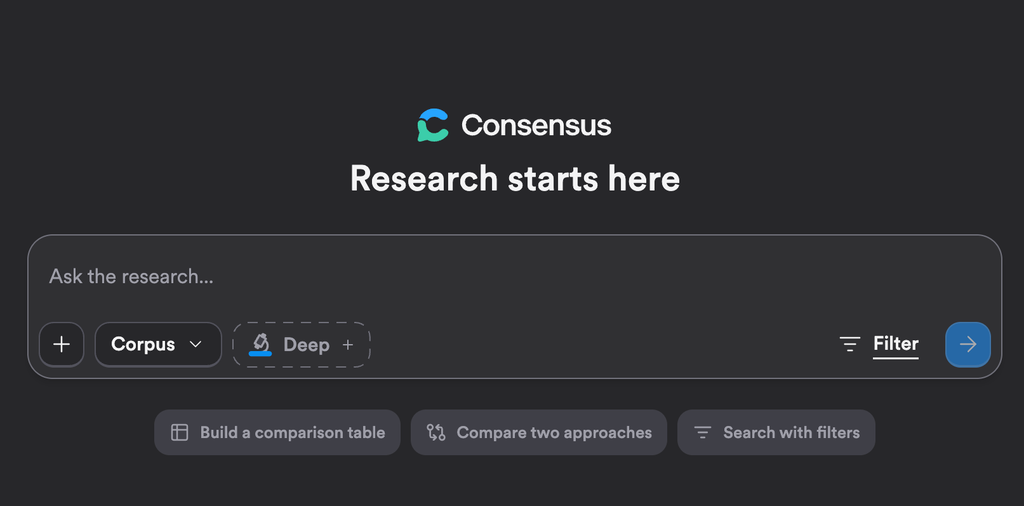
Consensus is probably the closest thing we currently have to an AI-powered academic search assistant. Unlike general chatbots, Consensus is built around peer-reviewed literature. Instead of generating random claims, it searches scientific papers directly and synthesizes evidence-based answers.
A More Research-Oriented Interface
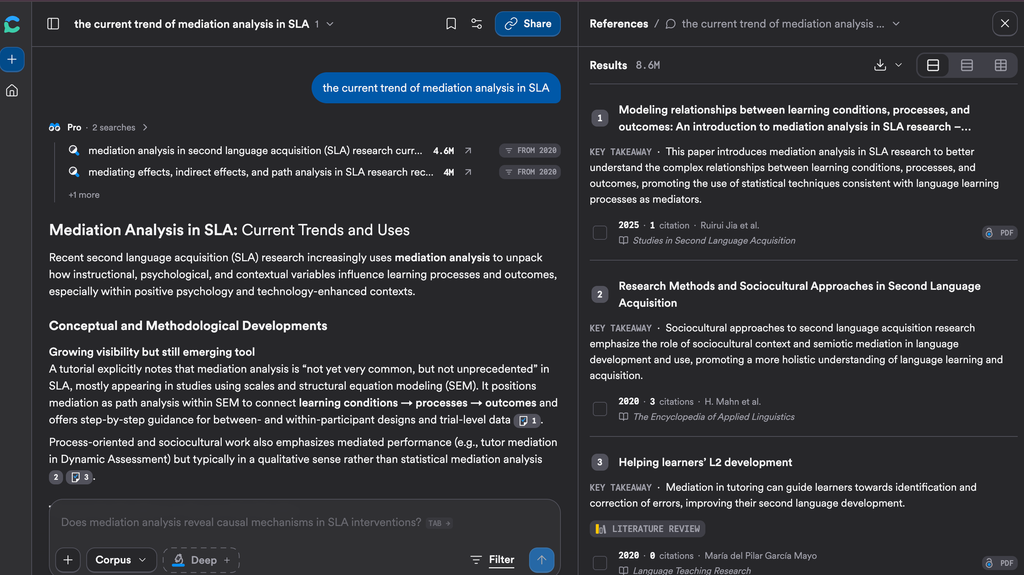
The most powerful feature shown in the screenshot is the automatic research synthesis panel.
Instead of simply displaying a long list of papers, Consensus generates a structured overview:
- Current research trends
- Methodological developments
- Key findings
- Emerging debates
Consensus vs. Google Scholar: The Core Difference
The biggest difference is philosophy. Google Scholar is fundamentally a search engine. Consensus is becoming an AI-powered research reasoning system.
| Feature | Consensus | Google Scholar |
|---|---|---|
| Search Style | Natural-language questions | Keyword matching |
| AI Summary | Yes | No |
| Literature Synthesis | Built-in | Manual |
| Research Insights | Generated automatically | User-dependent |
| Reading Workflow | Interactive | Link-based |
Google Scholar answers:
“Which papers contain these keywords?”
Consensus attempts to answer:
“What does the research community currently know about this topic?”
That distinction is transformative for academic writing in 2026.
Rather than replacing critical thinking, Consensus reduces mechanical research labor , allowing scholars to focus more on analysis, argumentation, and knowledge creation. And that may be the real future of academic writing.
Elicit — The Best AI Tool for Literature Reviews
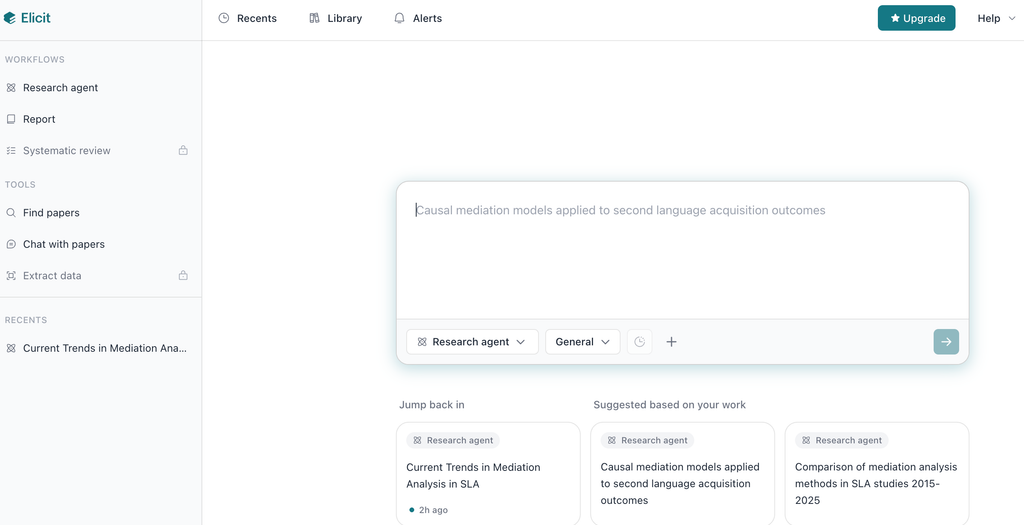
If Consensus helps you find evidence, Elicit helps you organize and analyze it.
Elicit is exceptionally strong at:
- literature review workflows
- evidence synthesis
- variable extraction
- methodology comparison
- and research mapping
This is where it becomes far more useful than a normal chatbot. Instead of producing generic summaries, Elicit can extract structured information.
Built for Literature Review Workflows
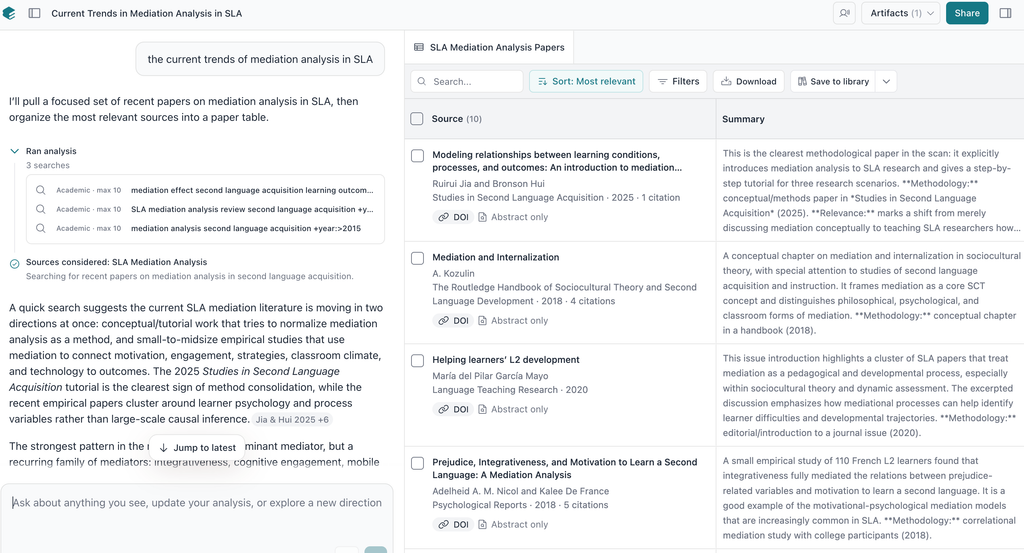
The screenshot reveals that Elicit is highly optimized for one of the most time-consuming academic tasks:
Literature Review Construction
Notice several workflow-oriented features:
- source filtering
- relevance sorting
- save-to-library system
- AI-generated summaries attached to each paper
This means researchers can move from:
searching → screening → comparing → synthesizing
without switching between multiple tools.
Transparency Is a Major Academic Advantage
One underrated aspect of Elicit is that it exposes the research process itself.
The interface openly shows:
- search strategies
- selected queries
- source consideration logic
This is important in academic environments where:
- reproducibility matters
- methodological rigor matters
- source traceability matters
Unlike generic AI chatbots that often produce opaque outputs, Elicit keeps researchers connected to the evidence-generation process.
For graduate students and researchers, this improves trust and reduces hallucination risk.
Paperpal — The Best AI for Academic Language Polishing
Most AI writing tools are trained on the internet. Paperpal is trained for scholarly communication. That difference becomes obvious immediately. Unlike generic grammar checkers, Paperpal understands academic tone, conciseness, and formal scholarly conventions. So it performs especially well for non-native English researchers, journal submissions, thesis editing, and manuscript polishing.
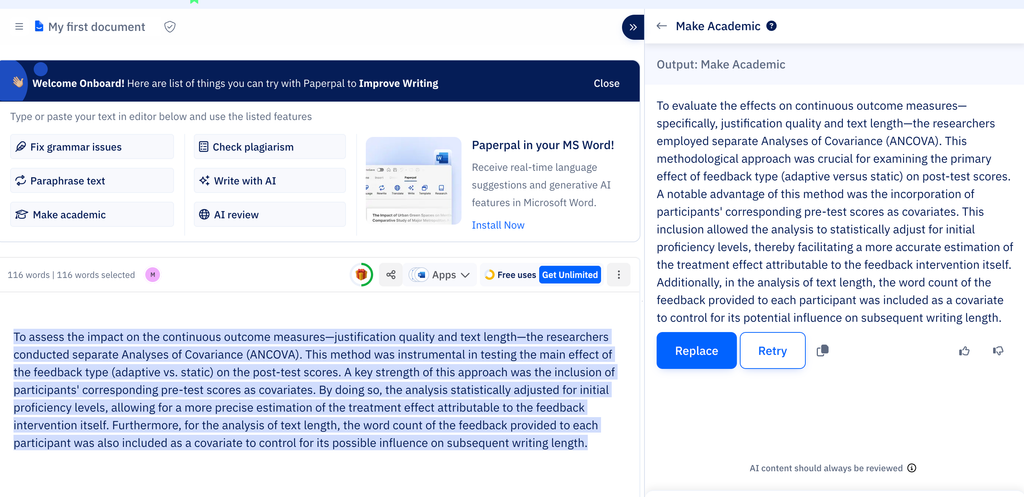
The “Make Academic” Feature Reveals Paperpal’s Biggest Strength
The screenshot specifically demonstrates the “Make Academic” function.
On the left:
- the original paragraph
On the right:
- a more formal, publication-oriented academic rewrite
This side-by-side structure is extremely important because it creates controllable AI editing.
Researchers can:
- compare revisions directly
- evaluate wording changes
- retain disciplinary accuracy
- decide whether to accept modifications
Unlike fully generative AI systems that may rewrite aggressively or hallucinate information, Paperpal behaves more like an intelligent academic editor.
Turning Research into Publication- Ready Academic Writing
From the interface shown above, Paperpal clearly positions itself not as a research discovery platform, but as an AI-powered academic writing environment optimized for polishing, rewriting, and refining scholarly text.
The UI immediately highlights practical writing functions such as:
- Make academic
- Check plagiarism
- AI review
- Write with AI
This reveals Paperpal’s core philosophy:
improving academic expression rather than discovering academic information.
In other words, Paperpal operates closer to the writing and editing layer of academic workflow.
The Ethical Problem: AI Should Not Replace Thinking
The academic AI industry also has a growing credibility problem. Many tools now advertise things like:
- “Write your thesis instantly”
- “Generate full research papers in minutes”
- “Publish papers effortlessly with AI”
These claims should be treated with skepticism. Academic writing is not content production. Real research requires theoretical understanding, methodological rigor, and intellectual responsibility. AI can assist the process. It cannot replace scholarship itself.
Researchers who rely entirely on AI-generated arguments often produce shallow content. More importantly, overreliance on AI undermines the entire purpose of higher education:
the development of independent thinking.
The best use of AI in academia is not automation.
It is augmentation.
The Future of Academic Writing Is AI Workflows

In 2026, academic writing is no longer about relying on a single AI tool to do everything. The real breakthrough comes from combining specialized AI tools into a seamless research workflow.
The most effective academic workflow in 2026 is not:
“One AI that does everything.”
Instead, it is a specialized ecosystem:
- Consensus quickly verify scientific consensus and discover credible sources,
- Elicit simplifies literature review and research synthesis,
- and Paperpal enhances academic writing through language refinement, clarity improvement, and publication-ready editing.
Together, these tools create a powerful end-to-end workflow that supports every stage of the research process , from finding evidence to organizing ideas and polishing the final manuscript.
The researchers who benefit most from AI will not be the ones who let AI think for them.
They will be the ones who use AI to think better.

Related Articles

Managing PR campaigns manually can quickly become overwhelming, especially for teams handling media outreach, monitoring, reporting, and social media at the same time.