Best Copywriting Agent Skills in 2026
Discover the best copywriting agent skills for persuasive content creation, audience targeting, brand voice consistency, and high-converting marketing campaigns.
AI can write faster than ever. But most AI-generated copy still sounds exactly like what it is: AI-generated copy.
You see the same phrases everywhere:
- “streamline workflows”
- “boost productivity”
- “optimize efficiency”
- “AI-powered solution for modern teams”
Technically correct. Completely forgettable.
The problem is not that AI cannot write. The problem is that most AI tools still do not understand how persuasion actually works.
TL; DR
- MarketingSkills Copywriting — The Conversion Funnel Strategist
Best for structured SaaS marketing copy, emotional escalation, and conversion-focused frameworks like PAS, AIDA, and BAB. - MarketingSkills Conversion Copywriting Skill
Best for landing pages, CTA optimization, and turning boring product features into clear customer outcomes. - JK-0001 Copywriting — The Conversion Framework Specialist
Best for high-converting headlines, emotional hooks, and founder-style SaaS messaging with strong marketing psychology. - Copywriting Pro — The Founder-Style SaaS Copywriter
Best for customer-avatar creation, objection handling, and emotionally persuasive startup copy that feels human instead of AI-generated. - KillerApp UX Copywriting Skill
It transforms generic SaaS messaging into cleaner, more human product copy,significantly improving onboarding flows, feature explanations, microcopy clarity, and UX friction reduction.
Top Copywriting Agent Skills: Quick Overview
| Tool Name | Best For |
|---|---|
| MarketingSkills Copywriting | Best for SaaS founders and marketers who need structured conversion copy. It performs especially well for landing pages, email funnels, CTA strategy, and persuasion frameworks like PAS or AIDA that require emotional escalation and clear customer positioning. |
| MarketingSkills Conversion Copywriting Skill | Best for improving product messaging and homepage clarity. This skill excels at rewriting weak headlines, strengthening CTAs, and transforming technical features into customer-focused outcomes that feel more human, persuasive, and conversion-oriented. |
| JK-0001 Copywriting | Best for startups that want emotionally engaging SaaS copy. It is especially strong at headline writing, founder-style storytelling, emotional tension, and marketing psychology that makes AI-generated copy feel more like modern startup branding. |
| Copywriting Pro | Best for AI startups, SaaS tools, and founder-led brands that need emotionally persuasive copy. This skill stands out in customer-avatar development, objection handling, and startup messaging that sounds commercially aware instead of generic AI writing. |
| KillerApp UX Copywriting Skill | Best for SaaS teams, product designers, and founders who need clearer onboarding flows, UX microcopy, dashboard messaging, and feature explanations. This skill excels at reducing friction, simplifying technical language, and making product communication feel more human, intuitive, and user-friendly. |
Now, let’s get to know more about these Copywriting Agent SKills.
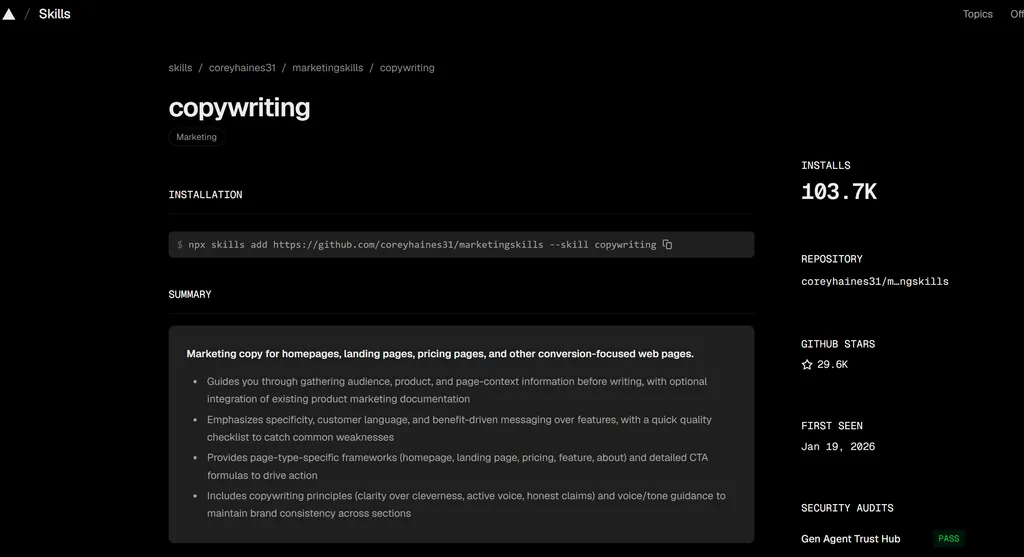
MarketingSkills Copywriting — The Conversion Funnel Strategist
Conversion Framework Mastery
This skill performed extremely well across classic copywriting frameworks like:
- PAS
- AIDA
- Before-After-Bridge
The biggest improvement was framework awareness.
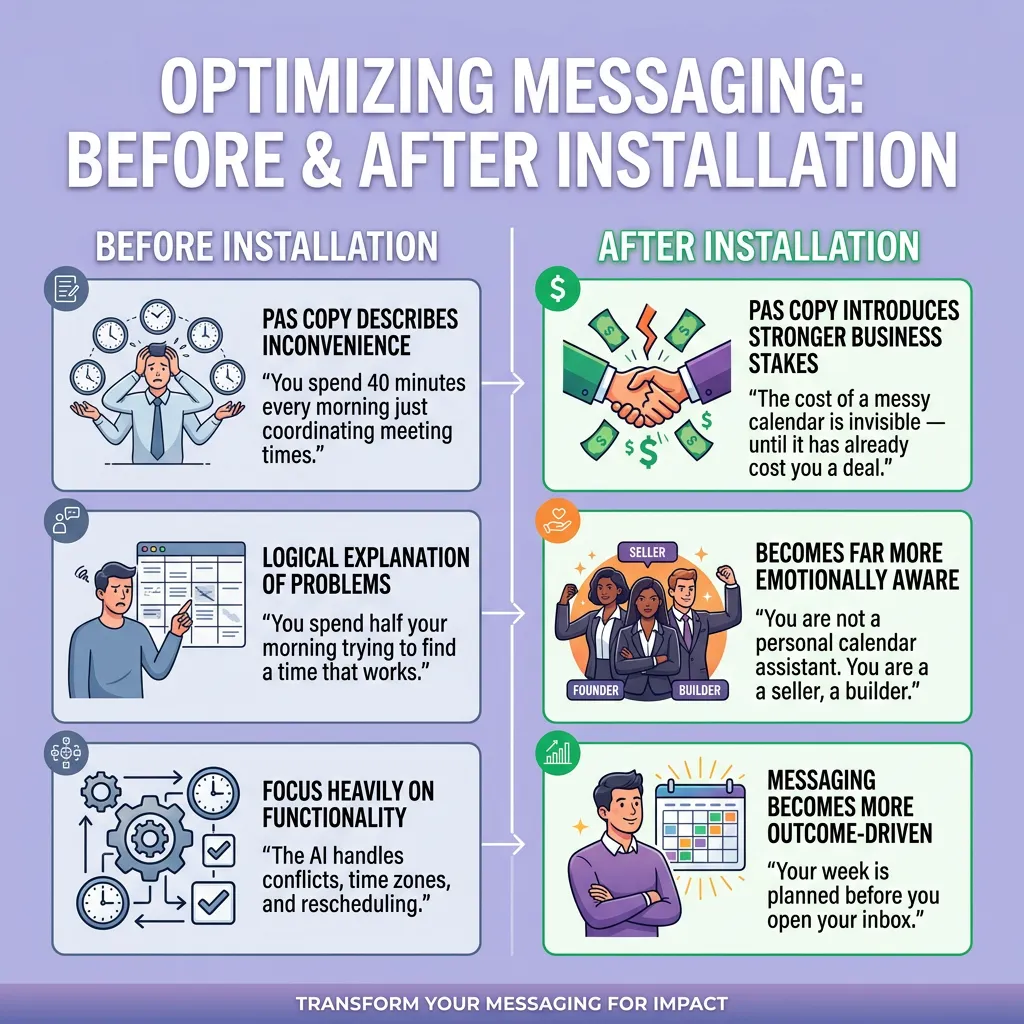
Before installation, the PAS copy mainly described inconvenience:
“You spend 40 minutes every morning just coordinating meeting times.”
After installation, the same framework introduced much stronger business stakes:
“The cost of a messy calendar is invisible — until it has already cost you a deal.”
The AI became much better at understanding the role of each framework:
- PAS focused on emotional escalation
- AIDA built curiosity and desire
- Before-After-Bridge emphasized transformation
The outputs felt structured and strategic instead of sounding like generic AI templates.
Emotional & Psychological Persuasion
This was one of the clearest upgrades during testing.
Before installation, the writing explained problems logically:
“You spend half your morning trying to find a time that works.”
After installation, the copy became far more emotionally aware:
“You are not a personal calendar assistant. You are a founder, a seller, a builder.”
That shift introduced:
- identity-based copywriting
- emotional tension
- customer empathy
- psychological positioning
The emotional trigger tests improved significantly as well.
For example, the “fear” section evolved from:
“Every hour you spend on invoicing is an hour you're not billing.”
to:
“The question is not whether you can afford to automate. It is whether you can afford not to.”
That single addition dramatically increased:
- urgency
- pressure
- conversion psychology
The AI stopped merely describing inconvenience and started framing emotional and business consequences.
SaaS-Style Conversion Messaging
Another major improvement was how the AI translated features into outcomes.
Before installation, the copy focused heavily on functionality:
“The AI handles conflicts, time zones, and rescheduling.”
After installation, the messaging became more outcome-driven:
“Your week is planned before you open your inbox.”
That change made the product feel:
- simpler
- more valuable
- more emotionally appealing
The CTA tests also showed much stronger marketing awareness.
Instead of generic calls-to-action, the skill generated multiple persuasion angles:
“Take 2 minutes to see how it works”
“Get back 8 hours a week — start free”
“Get your weekends back”
The writing style overall became much closer to modern SaaS landing page copy:
- shorter sentences
- conversational rhythm
- founder-style storytelling
- conversion-focused messaging
The outputs consistently felt more like real startup marketing rather than standard AI-generated copy.
Key Copywriting Features
Use Cases
This skill is especially effective for:
- SaaS landing pages
- startup marketing copy
- email funnels
- CTA optimization
- founder-led storytelling
The strongest use case is structured marketing copy that requires:
- persuasion frameworks
- emotional escalation
- multiple CTA angles
- customer pain positioning
- conversion-oriented messaging
Overall, this skill feels less like a generic AI writer and more like a conversion-focused SaaS marketer that understands:
- positioning
- persuasion
- emotional framing
- funnel psychology
- customer motivation
That difference became very obvious throughout the before-and-after testing.
MarketingSkills Conversion Copywriting Skill
Stronger Outcome-Driven Headlines
Before installing the skill, the copy focused mostly on functionality:
“Never Take Meeting Notes Again.”
It was clear, but still generic. The headline described the task being removed, not the deeper outcome.
After installing the skill, the messaging became sharper and more conversion-focused:
“Every Meeting. Summarized. In 30 Seconds.”
The improvement is obvious. The copy now introduces:
- speed (“In 30 Seconds”)
- rhythm and punchier sentence structure
- stronger perceived value
- clearer positioning
The same improvement appears in the subheadline.
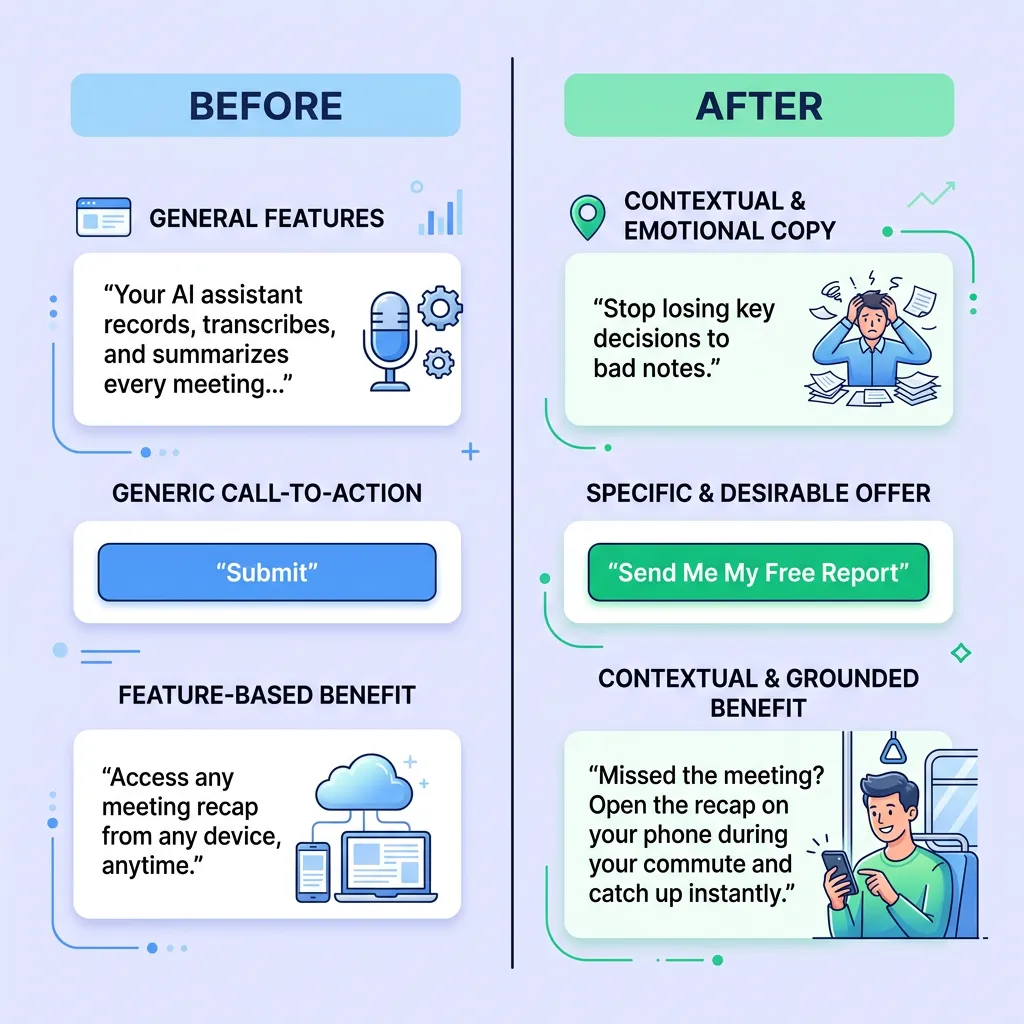
Before:
“Your AI assistant records, transcribes, and summarizes every meeting...”
After:
“Stop losing key decisions to bad notes.”
The installed skill shifts from feature explanation to pain-focused positioning. Instead of describing software functions, it frames the business consequence of poor note-taking.
This makes the copy feel much more SaaS-oriented and conversion-aware.
Better CTA Psychology
One of the biggest upgrades was CTA rewriting.
Before installation, the CTAs were functional but weak:
| Weak CTA | Rewritten CTA |
|---|---|
| Submit | Get My Meeting Summary |
| Learn More | See How It Works |
| Continue | Unlock My Free Account |
The installed skill consistently improved CTAs by adding:
- specificity
- ownership language (“My” / “Your”)
- low-friction framing
- clearer outcomes
For example:
“Submit” → “Send Me My Free Report”
This changes the CTA from a generic action into a value-driven promise.
Another strong example:
“Get Started” → “Claim Your Free Workspace”
The copy now creates perceived ownership and makes the offer feel tangible.
This is classic conversion copywriting psychology. The AI starts writing like a landing page optimizer instead of a generic text generator.
Feature-to-Benefit Translation Became Much More Human
Before installation, the copy translated features into benefits reasonably well:
“Access any meeting recap from any device, anytime.”
But after installation, the copy became more contextual and emotionally grounded:
“Missed the meeting? Open the recap on your phone during your commute and catch up instantly.”
The installed skill consistently added:
- real-life usage scenarios
- conversational framing
- emotional relevance
- clearer user outcomes
Another major improvement:
Before:
“Your whole team sees and edits notes live.”
After:
“Everyone edits the same doc live, so disagreements about ‘what was decided’ disappear.”
The new version introduces workplace tension and resolves it directly. Instead of explaining collaboration features, it explains why collaboration matters.
That is a major copywriting upgrade.
Before and After Installation
Use Cases
This skill works especially well for:
- SaaS landing pages
- product positioning
- startup homepage copy
- CTA optimization
- feature-to-benefit rewriting
- onboarding flows
- meeting/productivity tools
- conversion-focused web copy
It is particularly strong at turning flat product descriptions into customer-oriented messaging.
For example, instead of saying:
“AI-generated meeting summaries”
the installed version reframes it as:
“Never rewatch a recording again.”
That is a major shift from feature language to outcome language.
The skill is also highly effective for founders and marketers who struggle to make technical products sound emotionally compelling. It consistently adds clearer positioning, stronger user motivation, and more persuasive framing without making the copy overly complicated.
JK-0001 Copywriting — The Conversion Framework Specialist
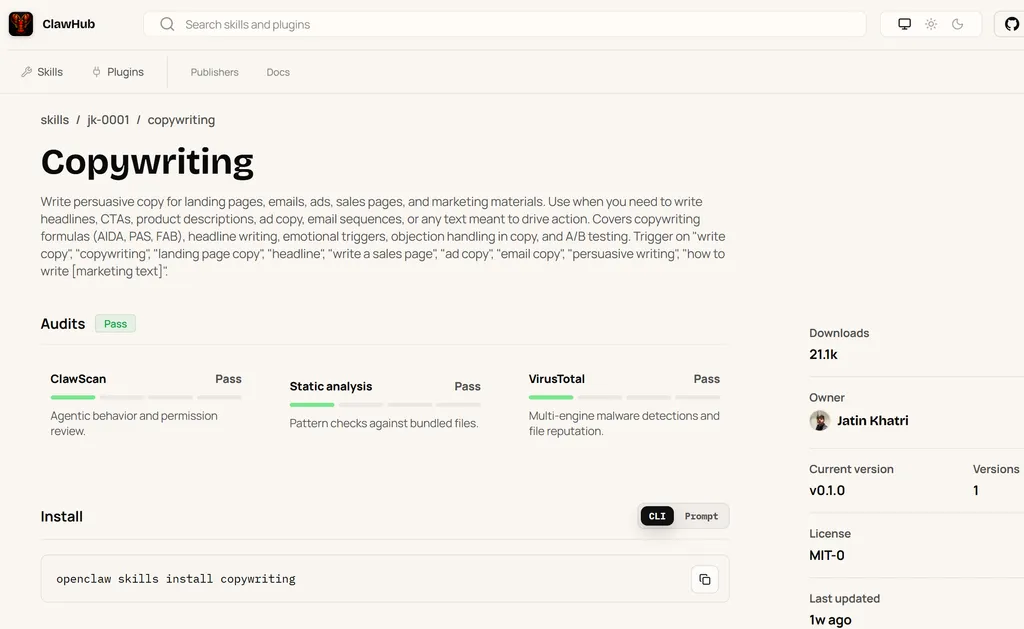
Stronger Headline Psychology
This was the clearest improvement during testing.
Before:
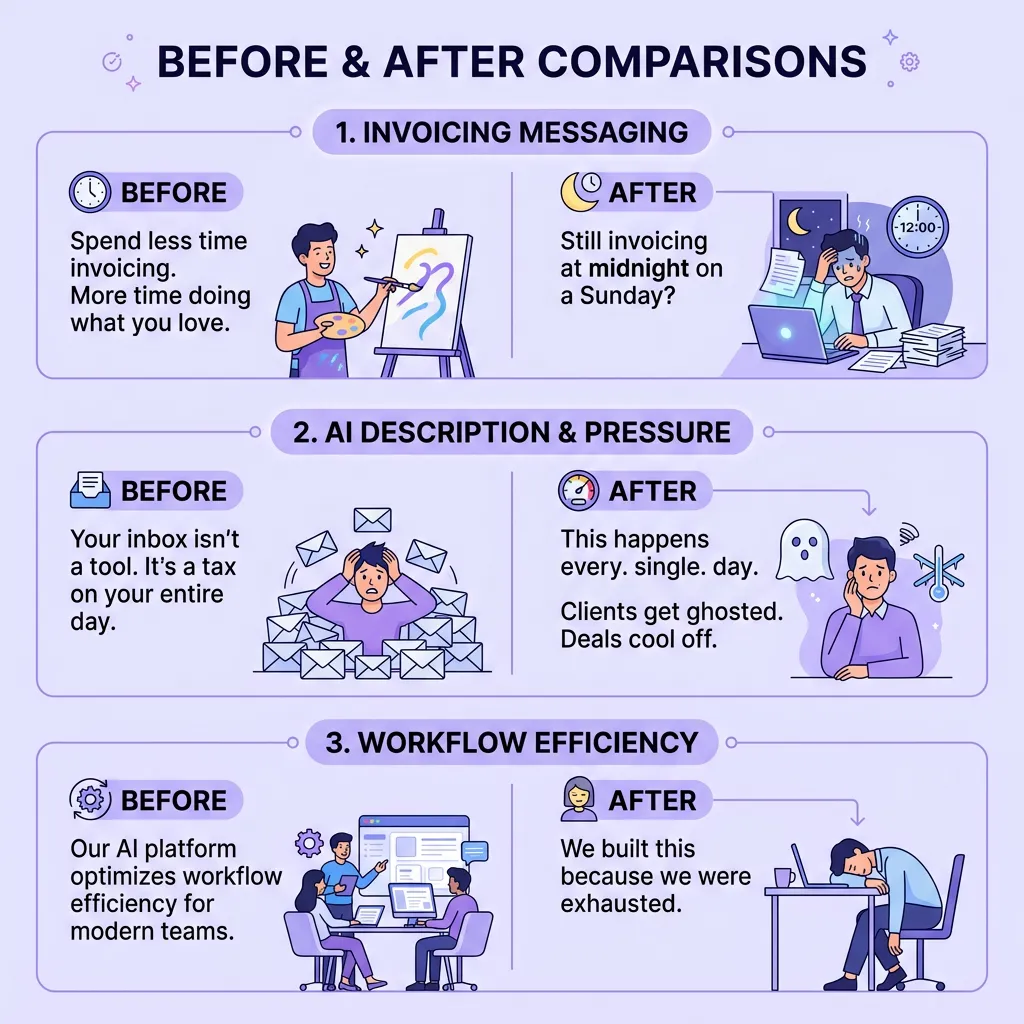
“Spend less time invoicing. More time doing what you love.”
After:
“Still invoicing at midnight on a Sunday?”
The post-installation version creates:
- stronger emotional tension
- scene-setting
- self-identification
- curiosity
The skill became significantly better at:
- marketing angles
- fear-of-loss framing
- transformation headlines
- emotional positioning
Instead of simply describing products, it started writing conversion-oriented hooks.
Better Emotional Escalation
The PAS copy tests improved dramatically.
Before installation, the AI mostly described inconvenience:
“Your inbox isn't a tool. It's a tax on your entire day.”
After installation, the AI started creating emotional pressure:
“This happens every. single. day.”
And:
“Clients get ghosted. Deals cool off.”
The copy became much more persuasive because it introduced:
- business consequences
- identity-based frustration
- opportunity-cost framing
- emotional escalation
One of the strongest lines was:
“You didn't take this job to be a professional email-reply machine.”
That feels much closer to real SaaS marketing copy than standard AI output.
More Human Founder-Style Writing
The rewrite tests also showed a major reduction in “corporate AI tone.”
Before:
“Our AI platform optimizes workflow efficiency for modern teams.”
After:
“We built this because we were exhausted.”
The writing became:
- shorter
- more conversational
- less abstract
- more founder-like
Lines like:
“No new dashboard to learn. Just less noise, more shipping.”
felt much closer to modern startup messaging from companies like Linear or Basecamp.
Before and After Installation
Use Cases
This skill works especially well for:
- SaaS landing pages
- startup websites
- AI product marketing
- founder-led brands
- conversion-focused copy
- onboarding headlines
- direct-response marketing
The biggest strength of this skill is simple:
It upgrades AI from “writing sentences” into “understanding marketing psychology.”
Copywriting Pro — The Founder-Style SaaS Copywriter
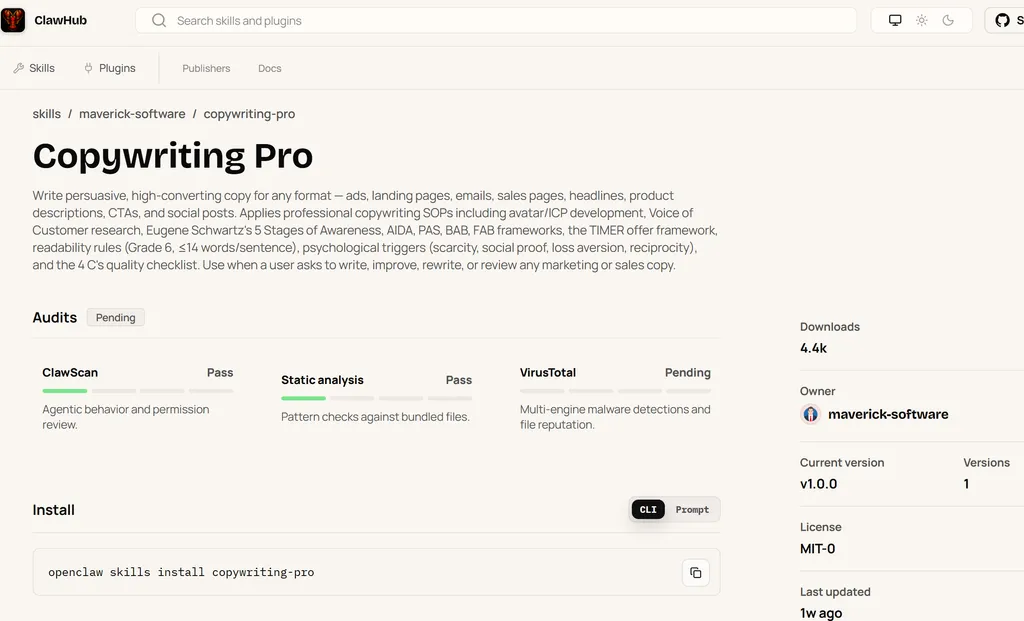
Stronger Customer Awareness
One of the clearest upgrades appeared in the customer avatar tests.
Before installation, the AI described broad user groups:
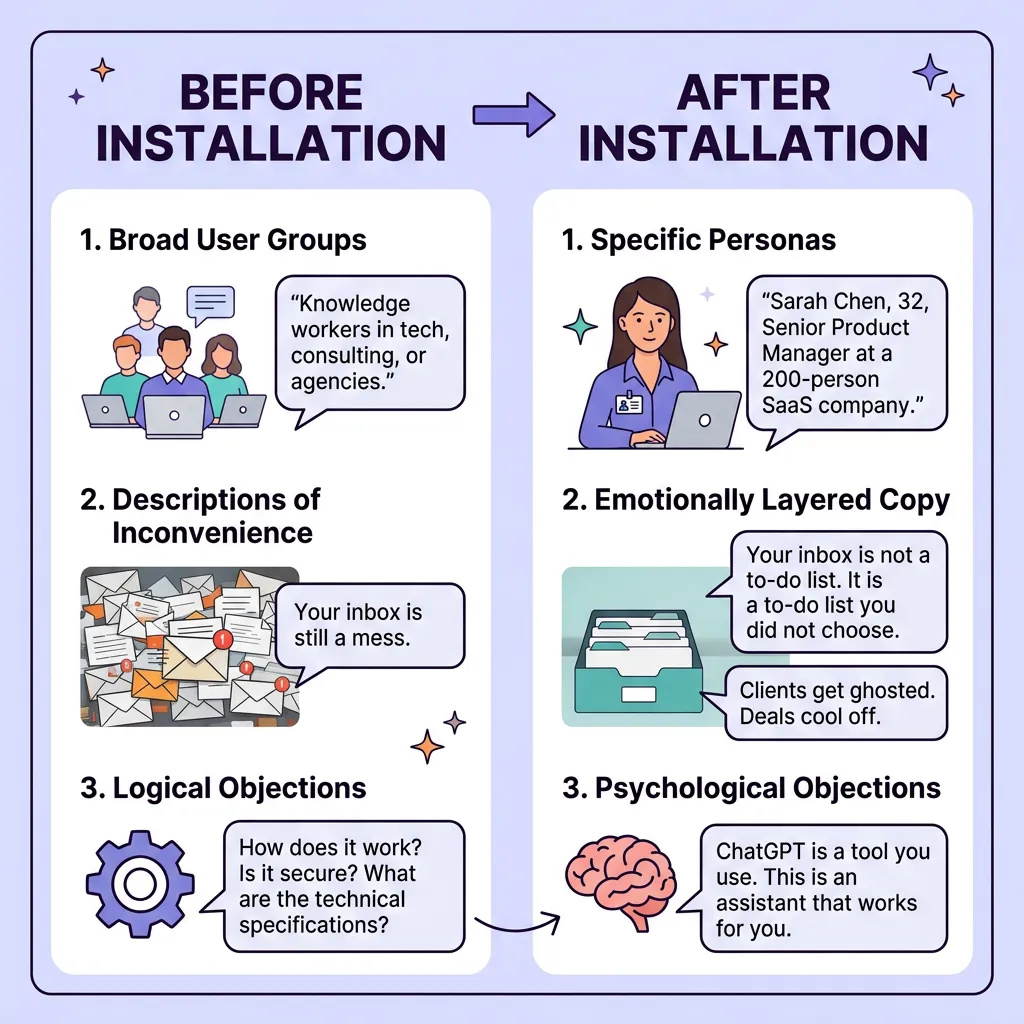
“Knowledge workers in tech, consulting, or agencies.”
After installation, the copy became dramatically more specific:
“Sarah Chen, 32, Senior Product Manager at a 200-person SaaS company.”
That single change immediately made the writing:
- more believable
- more human
- more emotionally relatable
The AI also became much better at:
- role-specific frustrations
- emotional stakes
- workflow realism
- identity-based pain points
Instead of generic user research, the skill started creating realistic customer psychology.
Lines like:
“She joined product management to build things. Not to transcribe them.”
felt much closer to real startup copywriting and user research.
Much Better Emotional Escalation
This was the strongest area of improvement.
Before installation, the AI mainly described inconvenience:
“Your inbox is still a mess.”
After installation, the copy became far more emotionally layered:
“Your inbox is not a to-do list. It is a to-do list you did not choose.”
And:
“Clients get ghosted. Deals cool off.”
The skill became significantly better at:
- emotional pressure
- opportunity-cost framing
- fear of loss
It no longer simply explained problems.
It amplified emotional and business consequences.
Better Objection Handling
The objection-handling tests improved significantly after installation.
Before installation, objections were answered logically.
After installation, they were answered psychologically.
For example:
“ChatGPT is a tool you use. This is an assistant that works for you.”
That line reframes the entire comparison emotionally instead of technically.
The AI also became much better at:
- reducing friction
- reinforcing control
- ROI framing
- simplifying adoption
- minimizing perceived risk
The responses felt much more conversion-focused and commercially aware.
Before and After Installation
Use Cases
This skill performs especially well for:
- SaaS landing pages
- AI startup marketing
- founder-led brands
- conversion copy
- email funnels
- objection handling
- product positioning
- customer-avatar development
It is particularly strong for users who want AI-generated copy to feel:
- more persuasive
- more emotionally aware
- more conversion-oriented
- more like real startup marketing
The biggest strength of this skill is simple:
It teaches AI how to think like a SaaS marketer, not just a content generator.
KillerApp UX Copywriting Skill
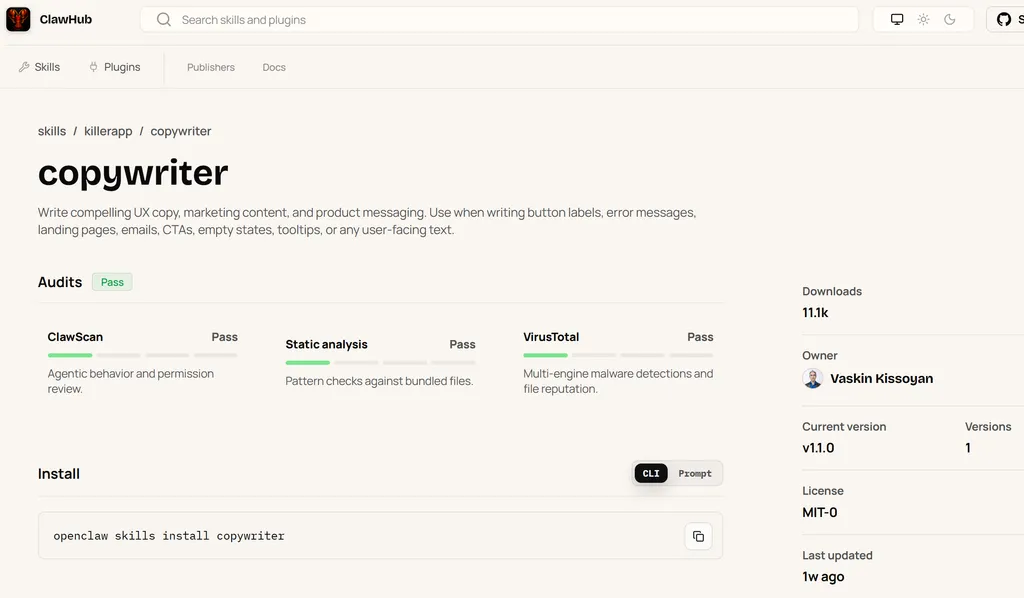
Clearer UX-Oriented Product Messaging
This skill performed especially well at simplifying product explanations without losing clarity.
Before installation, the feature explanations were already understandable:
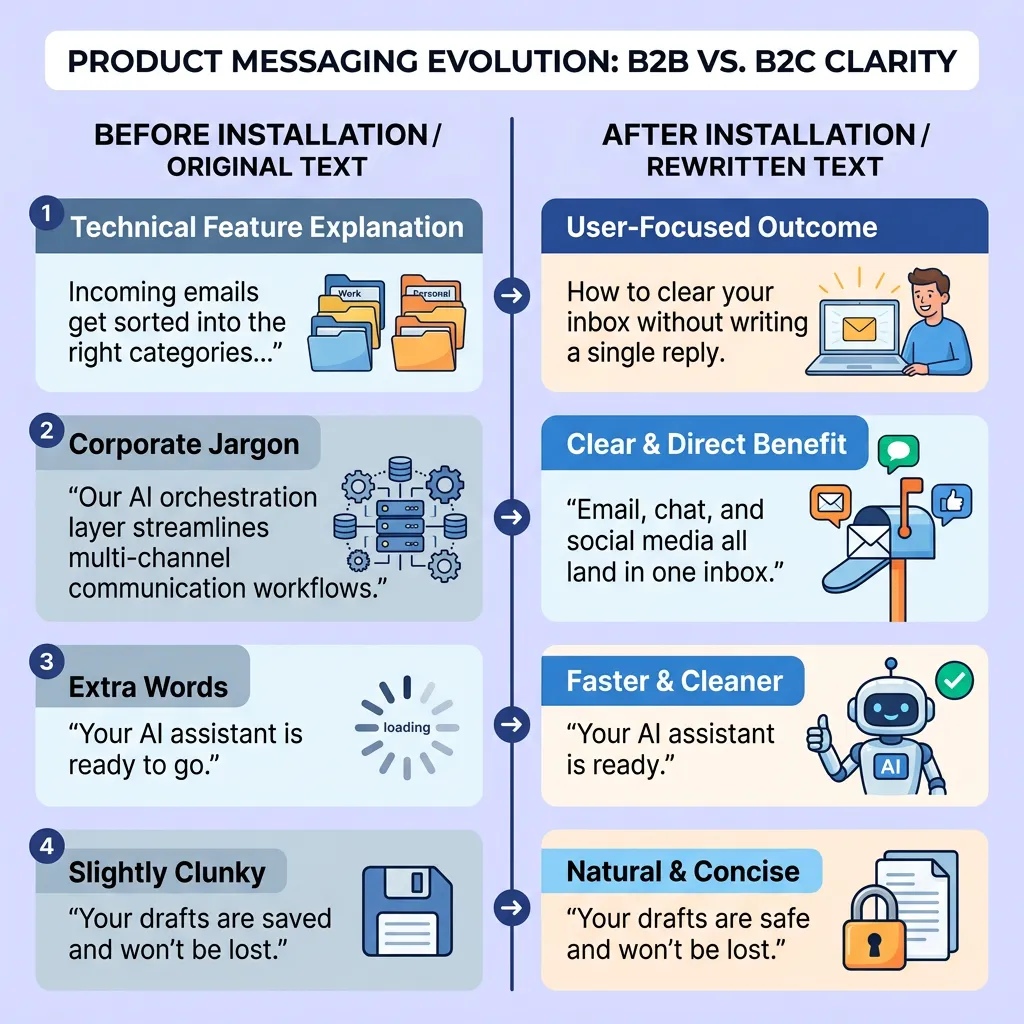
“Incoming emails get sorted into the right categories…”
But after installation, the messaging became much more user-focused and outcome-oriented:
“How to clear your inbox without writing a single reply.”
That change immediately improved:
- curiosity
- clarity
- perceived value
- user motivation
The installed skill consistently reframed features around user experience instead of technical functionality.
Another strong improvement appeared in onboarding copy.
Before:
“AI writes a reply you'd actually send.”
After:
“AI writes a reply in your voice.”
That small rewrite made the product feel:
- more personal
- more human
- more trustworthy
The copy started sounding less like software documentation and more like a polished SaaS product experience.
Stronger Clarity & Simplicity
One of the clearest upgrades was reduction of corporate AI language.
The original sentence:
“Our AI orchestration layer streamlines multi-channel communication workflows.”
was rewritten into:
“Email, chat, and social media all land in one inbox.”
The installed skill became much better at:
- removing jargon
- shortening explanations
- improving readability
- simplifying product communication
Another improvement:
Before:
“routes messages to the right person”
After:
“sends them to the right person”
The difference is subtle, but much more conversational and human.
The outputs consistently felt:
- cleaner
- easier to scan
- more UX-oriented
- less “AI-generated”
This is especially valuable for SaaS onboarding and in-product messaging where clarity matters more than cleverness.
Better UX Friction Reduction
This was one of the most impressive strengths during testing.
The installed skill noticeably improved:
- onboarding flow copy
- empty states
- loading states
- error messaging
- reassurance language
For example:
Before:
“Your drafts are saved and won't be lost.”
After:
“Your drafts are safe and won't be lost.”
That single word change adds emotional reassurance and reduces anxiety during errors.
The loading states also became more concise and readable:
Before:
“We're sorting through everything and drafting replies.”
After:
“We're sorting messages and drafting replies.”
The installed skill consistently removed unnecessary wording and improved interaction flow clarity.
It clearly understands modern UX writing principles:
- reduce friction
- lower cognitive load
- reassure users
- guide action clearly
Before and After Installation
Use Cases
This skill works especially well for:
- SaaS onboarding flows
- product UX writing
- dashboard tooltips
- empty states
It is particularly useful for founders and SaaS teams that struggle with:
- overly technical language
- AI-sounding product copy
- confusing onboarding experiences
- cluttered interface messaging
The biggest advantage of this skill is simple:
It teaches AI how to write like a UX copywriter instead of a generic AI marketer.
The Best Copywriting Skill Depends on What You’re Trying to Write
After testing these copywriting agent skills side by side, one thing became obvious very quickly:
Most AI tools can already produce decent sentences.
That is no longer the hard part.
The real difference appears when you ask AI to:
- create emotional tension
- position a product
- handle objections
- write like an actual SaaS founder
Some skills were clearly better at conversion-focused landing pages.
Others were better at:
- onboarding copy
- UX messaging
- CTA writing
- emotional storytelling
- customer psychology
And honestly, that makes sense.
A founder writing a homepage for an AI startup needs very different copy from a product designer writing onboarding flows or tooltip text.
That is why there is no universal “best” copywriting agent skill.
The right one depends on:
- what you are building
- who you are selling to
- how you communicate
- and what kind of customer experience you want to create
The most interesting part of testing these skills was not seeing AI become “better at writing.”
That is the point where AI copy starts feeling less like generated text — and more like real marketing.

Related Articles
A marketer-focused shortlist of the best Hermes Agent skills in 2026, plus a rubric to choose and maintain skills that ship real work.
Discover the best cold email agent skills for lead generation, personalized outreach, follow-ups, and reply automation.